
I just got back from the Cafe Montmartre and the launch party for subTerrain magazine #46 (the "Bad Jobs" issue). All three winners of the Lush Triumphant contest were there to read. John Vigna read a chunk from his intense short story, "Hops," poetry winner Bill Pollett read a quick poem, and Michael Hall brought the house down with his non-fiction piece "Bukowski My Boilermaker."
Number 46 is sub-T's first full-colour issue, by the way, and it's a beaut.
Fancylady did her usual belting job as emcee and was even interviewed by Malcolm Parry from The Sun afterwards. I noticed Parry wasn't toting his camera and step-stool this evening, so don't look for any cleavage shots in the paper tomorrow.
To see and hear Fancylady in her true element, check out the Main Street Literary Tour Thursday evening as part of BC Book and Magazine Week.
Tuesday, April 24, 2007

Monday, April 23, 2007

Earth—Hibernaculum (Southern Lord)
Earth hit upon something brilliant with their last release, Hex: Or Printing in the Infernal Method, on which Dylan Carlson recast his drone/ambient metal ethic in cleanly plucked Telecaster tones. The resulting music was spare and ominous, a compelling soundtrack for staring out the window and watching the clouds roll in. This EP applies the Hex method to three songs from the Earth back catalogue, along with the 16-minute “A Plague of Angels” that saw release as half a split 12-inch with drone disciples SUNN O))). “Ouroboros Is Broken” (reworked from debut album Extra-Capsular Extraction) lumbers forth with a single extended riff that stands up well over 8 minutes of repetition. Carlson and drummer Adrienne Davies create the track’s framework while Steve Moore, Don McGreevy and Greg Anderson of SUNN O))) drape various colours and embellishments across it, using tones from Hammond B3, trombone, bass and synth. In its original context on Pentastar: In the Style of Demons (1996), I always thought that “Coda Maestoso In F (Flat) Minor” sounded like the end section of Yes’s “Starship Troopers.” The Hiberculanum version is slowed down and twanged up as to be nearly unrecognizable. This track is another exercise in single-riff dynamics with an extremely heavy payoff by the end. “Miami Morning Coming Down” is a piano-led piece incorporating some delicate fuzz guitar that builds into something jazzy and hypnotic. Possibly the least threatening (yet most intriguing) track on the EP, its placid demeanour is a tour de force of complementary tonal placement. The final track, “A Plague of Angels,” is the sort of Wild West death trip familiar to anyone who’s already basked in Hex’s dustbowl, making for a useful coda to that album.
Hiberculanum also contains a DVD with a documentary by Seldon Hunt entitled Within the Drone. The 50-minute film follows Earth on tour across Europe, with snippets of live performance (no complete songs, but enough to get a good feel for what they do on stage) and interview segments in which Carlson explains his fascination with slow music, touches on Earth’s place in the music scene and the band’s avoidance of convenient genre tags, and his own development as a guitar player. It’s a very nice companion to the EP, and one which matches the music quite well in its unhurried pace and straight-up presentation.
Wednesday, April 18, 2007

Tuesday, April 17, 2007
Despite what I said at the end of my previous post, I don't think I've reached my live-gig saturation point. If I hadn't been sick last weekend, I would have gone to see Black Betty at Pub 340. I didn't even know about this band until a week ago, when I started to see posters for their show. I figured any band with the gumption to align themselves with Leadbelly and Ram Jam might be worth checking out. Then, while home from work and browsing the StonerRock.com album reviews forum, I saw their name again, had a listen at their myspace site, and got all stoked about their show, which happened to be that very night. That kind of coincidence is a good omen. Unfortunately, the future Mrs. Mule provided the necessary sanity check. If I'd gone, my sinuses would have probably imploded as the first power chord was struck.
There would have been power chords, most assuredly. Black Betty are a heavy outfit, especially for a duo. They've got massive guitars, massive drums, and massive singing...yes, actual singing. Righteous [mp3]. I'll have to track them down soon to get the album and maybe do a little reviewage of my own here.
My big thing with attending live shows is avoiding regret, the kind that pierces me when I see old gig posters for bands like Husker Du, who played here in 1985 when I was a full two years away from having a clue, and then it was too late; they were gone. Or the kind of regret that nags me in the present, as it's doing these days as a reformed Van der Graaf Generator tours across Europe and England.
They've pared down to the trio of Hammill, Evans and Banton, having booted out David "Jaxonsax" Jackson at the end of their 2005 tour. The ousting was done with utmost secrecy from the band, which generated a tornado of speculation amongst the fans and making for a fractious few weeks on the PH/VdGG mailing list, let me tell you. For many people, Jaxon's multi-sax attack was VdGG's signature, and so the new "power trio" format was greeted with nervous anticipation. Hardly anyone dismissed them outright, however. And, bless them, they're making it work, with Banton cranking it to the max, keeping himself busier than ever on organ and pedals, and Hammill playing a lot more guitar than he's done in VdGG lineups past. "This is a f***ing brilliant grunge band with unorthodox instrumentation!" gushed a fan after one of their first shows. They've dusted off material like the fearsome "Gog" and personal favourite "Meurglys III (The Songwriter's Guild)," and even added two new songs to the set. While the 2005 reunion was imbued with a lot of nostalgia, this incarnation is something truly new, and they're pushing their playing and their music forward. It's progressive rock, after all.
I've thought about reviewing the whole VdGG catalogue here in an attempt to express how much this music means to me, but I've been finding lately that the more I plan, worry, and think about this blog, the harder it gets to sit down and write. Maybe I'll get down to it; that's the kind of difficult music I originally planned to chronicle here. As I've learned, though, this is no place for planning.
There would have been power chords, most assuredly. Black Betty are a heavy outfit, especially for a duo. They've got massive guitars, massive drums, and massive singing...yes, actual singing. Righteous [mp3]. I'll have to track them down soon to get the album and maybe do a little reviewage of my own here.
My big thing with attending live shows is avoiding regret, the kind that pierces me when I see old gig posters for bands like Husker Du, who played here in 1985 when I was a full two years away from having a clue, and then it was too late; they were gone. Or the kind of regret that nags me in the present, as it's doing these days as a reformed Van der Graaf Generator tours across Europe and England.
They've pared down to the trio of Hammill, Evans and Banton, having booted out David "Jaxonsax" Jackson at the end of their 2005 tour. The ousting was done with utmost secrecy from the band, which generated a tornado of speculation amongst the fans and making for a fractious few weeks on the PH/VdGG mailing list, let me tell you. For many people, Jaxon's multi-sax attack was VdGG's signature, and so the new "power trio" format was greeted with nervous anticipation. Hardly anyone dismissed them outright, however. And, bless them, they're making it work, with Banton cranking it to the max, keeping himself busier than ever on organ and pedals, and Hammill playing a lot more guitar than he's done in VdGG lineups past. "This is a f***ing brilliant grunge band with unorthodox instrumentation!" gushed a fan after one of their first shows. They've dusted off material like the fearsome "Gog" and personal favourite "Meurglys III (The Songwriter's Guild)," and even added two new songs to the set. While the 2005 reunion was imbued with a lot of nostalgia, this incarnation is something truly new, and they're pushing their playing and their music forward. It's progressive rock, after all.
I've thought about reviewing the whole VdGG catalogue here in an attempt to express how much this music means to me, but I've been finding lately that the more I plan, worry, and think about this blog, the harder it gets to sit down and write. Maybe I'll get down to it; that's the kind of difficult music I originally planned to chronicle here. As I've learned, though, this is no place for planning.
Friday, April 13, 2007
I've been a gigging madman recently. Here's a roundup of the latest.
Red Sparowes, March 20, at Richard’s on Richards
I bought tickets to this show on a hunch. It’s not often that a band on the esteemed Neurot Recordings comes to town. The hunch paid off hugely, as Red Sparowes are one of the most impressive post-metal atmospheric bands I’ve ever seen. Having three guitarists in one band is often a redundant exercise (hello, Iron Maiden), but the Sparowes guys had obviously worked really hard at arranging and orchestrating their parts. The projections—showing what looked like old Chinese propaganda films—were also a nice touch. As Smash wrote afterwards, “I'd go see that band five nights a week.” A scintillating performance.
The Mingler, April 4 at The Cobalt
I don’t normally hang out at The Cobalt on a Wednesday night, but a) it was Fake Jazz Wednesday, an event I’d been wanting to check out, and b) improv jazz/noise/metal trio The Mingler were on the bill. I’d never seen them before (indeed, had they even gigged before?), but with a lineup consisting of musical genii Jeff Younger, Alvaro Rojas and Mike Magnusson it was sure bet. They’ve got about 79 ongoing projects between them, and I’ve always been blown away by the few I’ve witnessed. The brief samples on Younger’s site had me expecting something structured around pre-written bass riffs. In actuality, they flew from idea to idea really quickly, favouring chaos over groove. This suited the vibe of the event, really. Rojas churned away while Jeff freaked out with his pedals, mashing strings, bursting into speed metal passages, and dropping down for more conventional jazz soloing.

Mmm, mingly.
A Ghost to Kill Again with Karen Foster and Bend Sinister, April 6 at The Waldorf
I hyperventilated about AGTKA’s debut album here a little while ago, and this gig was their long-awaited record release party. I’d never been to the Waldorf before, though I remember it as the premiere venue for the lounge scene when that was big for 15 minutes 10 years ago. It’s a nice room, actually. The bands just set up at one end on the floor, punk rock style. Karen Foster/Foster Kare rocked really hard, reminding me of an older, wiser Squirrel Bait overall. Their incredible energy got everyone primed for AGTKA, who proceeded to lay down the kind of beautiful destruction that makes life worth living. It’s rare to see a band tackle such demanding material and do it with such joy. Dominant and flabbergasting. Bend Sinister closed off the evening. Maybe it was the shot in the arm that AGTKA had just administered, but BS seemed a bit frantic in their approach. I remember their set at Richard’s opening for Sleepytime Gorilla Museum being a little more composed. Still, I love this band to bits. Knowing there’s a band in Vancouver running Supertramp and Gentle Giant through an indie rock cheese grater makes me very happy.
Unexpect, Anonymus, April 7 at The Balmoral
The turnout was small and disproportionately cretinous for these two bands who’d come all the way from Quebec. Anonymus were thrashy and a little generic, reminding me of DRI at some points. They were ready to have a good time and intent on giving the audience a good time as well. Unexpect managed to arrange all seven members on the multi-tiered stage and pulled off their set of crazy stop-start circus-freak metal without anyone getting hurt. I started feeling a little bad for them as the evening progressed, though. Here’s a world-class act playing a supposedly world-class city and all we could offer them was a gig in the grimmest neighbourhood in North America with a dozen people actually listening and being excited about their music, while the rest of the crowd sat in the smoking room or play-fought like silly buggers. Unexpect deserved better. Do Make Say Think, an equally art-damaged act that perhaps has the advantage of more “hip” press coverage, managed to fill a pretty big place like Richard’s, and I think Unexpect have that potential as well.
Dark Tranquillity, The Haunted, Into Eternity, Scar Symmetry, April 9 at The Croatian Culture Centre
From Quebec metal night, we move to Swedish metal night. Four bands and an all-ages gig makes for an early start time, so I only caught the last two songs of Scar Symmetry’s set. What I heard sounded quite a bit like In Flames, a realization that didn’t bring on the pangs of regret for missing them. Despite their sound misfiring, with half the drum kit missing from the mix, Saskatchewan’s Into Eternity went over a storm. Stu Block’s a born heavy metal frontman—we spotted his proud parents by the merch table—and Tim Roth is pretty much the ultimate guitar shredder. Extreme progressive death metal from Canada…what’s not to like? The Haunted just keep at it year after year, despite (arguably) never surpassing their 1998 debut. It’s good to see both Bjorler brothers and vocalist Peter Dolving back in the band. Not having kept up with the band’s output, most of the set whizzed past me in a big thrashy blur. The slower numbers had a good groove; perhaps Anders Bjorler’s Trouble t-shirt hinted at a more doom-rock sensibility at work in their newer material. Dark Tranquillity sounded huge, and their twin guitar work was the classiest thing I’d heard all night. DT also have a great frontman in Mikael Stanne…if only the man could do anything but growl. They did well with the crowd on their first gig in Vancouver and seem to have a following almost equal to In Flames, who’ve played here fairly regularly. After 45 minutes, I was feeling gigged out so I headed home for a bit of peace and quiet.
That ought to hold me for a while.
Red Sparowes, March 20, at Richard’s on Richards
I bought tickets to this show on a hunch. It’s not often that a band on the esteemed Neurot Recordings comes to town. The hunch paid off hugely, as Red Sparowes are one of the most impressive post-metal atmospheric bands I’ve ever seen. Having three guitarists in one band is often a redundant exercise (hello, Iron Maiden), but the Sparowes guys had obviously worked really hard at arranging and orchestrating their parts. The projections—showing what looked like old Chinese propaganda films—were also a nice touch. As Smash wrote afterwards, “I'd go see that band five nights a week.” A scintillating performance.
The Mingler, April 4 at The Cobalt
I don’t normally hang out at The Cobalt on a Wednesday night, but a) it was Fake Jazz Wednesday, an event I’d been wanting to check out, and b) improv jazz/noise/metal trio The Mingler were on the bill. I’d never seen them before (indeed, had they even gigged before?), but with a lineup consisting of musical genii Jeff Younger, Alvaro Rojas and Mike Magnusson it was sure bet. They’ve got about 79 ongoing projects between them, and I’ve always been blown away by the few I’ve witnessed. The brief samples on Younger’s site had me expecting something structured around pre-written bass riffs. In actuality, they flew from idea to idea really quickly, favouring chaos over groove. This suited the vibe of the event, really. Rojas churned away while Jeff freaked out with his pedals, mashing strings, bursting into speed metal passages, and dropping down for more conventional jazz soloing.

Mmm, mingly.
A Ghost to Kill Again with Karen Foster and Bend Sinister, April 6 at The Waldorf
I hyperventilated about AGTKA’s debut album here a little while ago, and this gig was their long-awaited record release party. I’d never been to the Waldorf before, though I remember it as the premiere venue for the lounge scene when that was big for 15 minutes 10 years ago. It’s a nice room, actually. The bands just set up at one end on the floor, punk rock style. Karen Foster/Foster Kare rocked really hard, reminding me of an older, wiser Squirrel Bait overall. Their incredible energy got everyone primed for AGTKA, who proceeded to lay down the kind of beautiful destruction that makes life worth living. It’s rare to see a band tackle such demanding material and do it with such joy. Dominant and flabbergasting. Bend Sinister closed off the evening. Maybe it was the shot in the arm that AGTKA had just administered, but BS seemed a bit frantic in their approach. I remember their set at Richard’s opening for Sleepytime Gorilla Museum being a little more composed. Still, I love this band to bits. Knowing there’s a band in Vancouver running Supertramp and Gentle Giant through an indie rock cheese grater makes me very happy.
Unexpect, Anonymus, April 7 at The Balmoral
The turnout was small and disproportionately cretinous for these two bands who’d come all the way from Quebec. Anonymus were thrashy and a little generic, reminding me of DRI at some points. They were ready to have a good time and intent on giving the audience a good time as well. Unexpect managed to arrange all seven members on the multi-tiered stage and pulled off their set of crazy stop-start circus-freak metal without anyone getting hurt. I started feeling a little bad for them as the evening progressed, though. Here’s a world-class act playing a supposedly world-class city and all we could offer them was a gig in the grimmest neighbourhood in North America with a dozen people actually listening and being excited about their music, while the rest of the crowd sat in the smoking room or play-fought like silly buggers. Unexpect deserved better. Do Make Say Think, an equally art-damaged act that perhaps has the advantage of more “hip” press coverage, managed to fill a pretty big place like Richard’s, and I think Unexpect have that potential as well.
Dark Tranquillity, The Haunted, Into Eternity, Scar Symmetry, April 9 at The Croatian Culture Centre
From Quebec metal night, we move to Swedish metal night. Four bands and an all-ages gig makes for an early start time, so I only caught the last two songs of Scar Symmetry’s set. What I heard sounded quite a bit like In Flames, a realization that didn’t bring on the pangs of regret for missing them. Despite their sound misfiring, with half the drum kit missing from the mix, Saskatchewan’s Into Eternity went over a storm. Stu Block’s a born heavy metal frontman—we spotted his proud parents by the merch table—and Tim Roth is pretty much the ultimate guitar shredder. Extreme progressive death metal from Canada…what’s not to like? The Haunted just keep at it year after year, despite (arguably) never surpassing their 1998 debut. It’s good to see both Bjorler brothers and vocalist Peter Dolving back in the band. Not having kept up with the band’s output, most of the set whizzed past me in a big thrashy blur. The slower numbers had a good groove; perhaps Anders Bjorler’s Trouble t-shirt hinted at a more doom-rock sensibility at work in their newer material. Dark Tranquillity sounded huge, and their twin guitar work was the classiest thing I’d heard all night. DT also have a great frontman in Mikael Stanne…if only the man could do anything but growl. They did well with the crowd on their first gig in Vancouver and seem to have a following almost equal to In Flames, who’ve played here fairly regularly. After 45 minutes, I was feeling gigged out so I headed home for a bit of peace and quiet.
That ought to hold me for a while.
Friday, April 06, 2007
Heaven and Hell, with Megadeth and Down, March 11/07, Pacific Coliseum
The crowd was the kind of multi-generational bouillabaisse that you get at these old-guard rock shows. From my vantage point on the general admission floor, there were enough case studies to fill a sociology text. The seven-year-old boy with the massive "Michael Bolton classic" crimped mullet throwing the horns from atop his parent/guardian's shoulders would merit a whole chapter of his own. Most of the teenagers there had dropped their allowance on Megadeth shirts, so Dave Mustaine and co were obviously a big draw.
Down played a good set of swingin' sludge metal. Phil Anselmo was definitely feeling the love, oozing sincerity and appreciation between songs. Drummer Jimmy Bower has to be one of the heaviest hitters I've seen. He nearly levitates on the windup for each downstroke. And Pepper Keenan's one of tastiest guitarists and coolest dudes in rock. I can't see Down ever headlining a show this size, but they made a great warmup act.
Megadeth had a lot of sound problems distracting them during their 45 minutes on stage. They did their best, but the stream of puzzled techs peering behind the amp stacks definitely divided the band's attention. If the bursts of feedback and bass guitar cutting in and out weren't enough, then a set list heavily biased towards newer Megadeth material didn't do much for me either. I'm still in denial over Chris Poland and Gar Samuelson leaving the band, so the early appearance of "Wake Up Dead" got me going, and post-Peace Sells... classics like "Symphony of Destruction" and "Holy Wars/Punishment Due" were good to hear as well. During the rest of the set I amused myself watching a single spotlight follow Mustaine's every move, leaving Glen Drover to solo away in the dark!
Heaven and Hell's first-ever show (I believe these musicians played in a band called Black Sabbath for many years) went down a storm. By now I'm sure everyone's seen setlists from the tour, so I'll summarize by saying they played everything you might have wanted to hear except for "Turn Up the Night." Personally, I was stoked to hear "Lady Evil" and "Sign of the Southern Cross," two songs that sort of define the parameters of Black Sabbath's music during the Dio years. The former is a good old hard rock stomper, while "Sign..." is a majestic epic with a classic Iommi riff. Dio was in good voice, faltering only a couple times on single words up in the high registers. He can still do it; they can all still do it. Along with all the Heaven and Hell and Mob Rules essentials, they played selections from Dehumanizer and three heavy new songs I believe they worked up for the Dio Years box set. No songs from the Ozzy years made it into the set (disappointing a certain tenured Georgia Straight critic), but that was as it should be. Iommi and Butler are shucking the stumbling spectre of their most famous frontman and re-establishing a band that played a big part in metal's ascendance in the early 80s. A triumphant kickoff for a revitalized (let's not deny it) Black Sabbath.


Photos courtesy Mr. Bob Sox.
The crowd was the kind of multi-generational bouillabaisse that you get at these old-guard rock shows. From my vantage point on the general admission floor, there were enough case studies to fill a sociology text. The seven-year-old boy with the massive "Michael Bolton classic" crimped mullet throwing the horns from atop his parent/guardian's shoulders would merit a whole chapter of his own. Most of the teenagers there had dropped their allowance on Megadeth shirts, so Dave Mustaine and co were obviously a big draw.
Down played a good set of swingin' sludge metal. Phil Anselmo was definitely feeling the love, oozing sincerity and appreciation between songs. Drummer Jimmy Bower has to be one of the heaviest hitters I've seen. He nearly levitates on the windup for each downstroke. And Pepper Keenan's one of tastiest guitarists and coolest dudes in rock. I can't see Down ever headlining a show this size, but they made a great warmup act.
Megadeth had a lot of sound problems distracting them during their 45 minutes on stage. They did their best, but the stream of puzzled techs peering behind the amp stacks definitely divided the band's attention. If the bursts of feedback and bass guitar cutting in and out weren't enough, then a set list heavily biased towards newer Megadeth material didn't do much for me either. I'm still in denial over Chris Poland and Gar Samuelson leaving the band, so the early appearance of "Wake Up Dead" got me going, and post-Peace Sells... classics like "Symphony of Destruction" and "Holy Wars/Punishment Due" were good to hear as well. During the rest of the set I amused myself watching a single spotlight follow Mustaine's every move, leaving Glen Drover to solo away in the dark!
Heaven and Hell's first-ever show (I believe these musicians played in a band called Black Sabbath for many years) went down a storm. By now I'm sure everyone's seen setlists from the tour, so I'll summarize by saying they played everything you might have wanted to hear except for "Turn Up the Night." Personally, I was stoked to hear "Lady Evil" and "Sign of the Southern Cross," two songs that sort of define the parameters of Black Sabbath's music during the Dio years. The former is a good old hard rock stomper, while "Sign..." is a majestic epic with a classic Iommi riff. Dio was in good voice, faltering only a couple times on single words up in the high registers. He can still do it; they can all still do it. Along with all the Heaven and Hell and Mob Rules essentials, they played selections from Dehumanizer and three heavy new songs I believe they worked up for the Dio Years box set. No songs from the Ozzy years made it into the set (disappointing a certain tenured Georgia Straight critic), but that was as it should be. Iommi and Butler are shucking the stumbling spectre of their most famous frontman and re-establishing a band that played a big part in metal's ascendance in the early 80s. A triumphant kickoff for a revitalized (let's not deny it) Black Sabbath.


Photos courtesy Mr. Bob Sox.
Tuesday, March 27, 2007
I'll try to salvage March by running down this month's shows.
Do Make Say Think at Richard's On Richards, March 5
The opening act was Westfalia—a kid with a laptop generating some cheery ambient music. That's about it. He could have set up anywhere in the venue and done the same thing. I think if you're going to get on stage with a laptop, you should hook up an LCD projector so the audience can see what you're doing...otherwise you'd better ensure your performance extends beyond looking like you're concentrating moderately hard at certain intervals. As you can tell, I'm not sold on the whole laptop performance genre. With eight musicians on stage (two drummers, a horn section, two guitarists, bassist and violinist), Do Make Say Think offered the packed house plenty to watch. The Torontonians did well to reproduce their recorded sound live, with additional force and ragged-ass noise. I've always liked that DMST don't neglect the "rock" in "post rock"and never miss an opportunity to add some crash/bang/wallop to their compositions. Another band might contently cruise through a similar set of riffs and grooves, afraid to break a sweat or be so uncool as to get "heavy." Still, DMST's set was more racous and jovial than I expected, on both the band's and the audience's part. I had to smile when the main theme of "Auberge Le Mouton Noir" got a big cheer of recognition. Who knew Do Make Say Think had "hits"? They played a good chunk of Winter Hymn Country Hymn Secret Hymn and the new album, You, You're a History in Rust. Of the new tunes, "Executioner's Blues" and its huge climactic surge—reminiscent of "21st Century Schizoid Man"—really stood out. The crowd loved it, except for possibly the couple parked next to me, who were too busy either swapping spit or staring at their cell phone to listen to the fine music unfolding in front of them. After the show, the soundman played us out with Voivod's "Missing Sequences," in case I wasn't feeling patriotic enough at that moment.
To be continued...
Do Make Say Think at Richard's On Richards, March 5
The opening act was Westfalia—a kid with a laptop generating some cheery ambient music. That's about it. He could have set up anywhere in the venue and done the same thing. I think if you're going to get on stage with a laptop, you should hook up an LCD projector so the audience can see what you're doing...otherwise you'd better ensure your performance extends beyond looking like you're concentrating moderately hard at certain intervals. As you can tell, I'm not sold on the whole laptop performance genre. With eight musicians on stage (two drummers, a horn section, two guitarists, bassist and violinist), Do Make Say Think offered the packed house plenty to watch. The Torontonians did well to reproduce their recorded sound live, with additional force and ragged-ass noise. I've always liked that DMST don't neglect the "rock" in "post rock"and never miss an opportunity to add some crash/bang/wallop to their compositions. Another band might contently cruise through a similar set of riffs and grooves, afraid to break a sweat or be so uncool as to get "heavy." Still, DMST's set was more racous and jovial than I expected, on both the band's and the audience's part. I had to smile when the main theme of "Auberge Le Mouton Noir" got a big cheer of recognition. Who knew Do Make Say Think had "hits"? They played a good chunk of Winter Hymn Country Hymn Secret Hymn and the new album, You, You're a History in Rust. Of the new tunes, "Executioner's Blues" and its huge climactic surge—reminiscent of "21st Century Schizoid Man"—really stood out. The crowd loved it, except for possibly the couple parked next to me, who were too busy either swapping spit or staring at their cell phone to listen to the fine music unfolding in front of them. After the show, the soundman played us out with Voivod's "Missing Sequences," in case I wasn't feeling patriotic enough at that moment.
To be continued...
Saturday, March 24, 2007
Still no fuggin' internet...reduced to posting a quickie playlist from a coffee shop.
1. Novembers Doom—The Novella Reservoir
2. Neil Young—Live at Massey Hall 1971
3. Martyr—Warp Zone
4. Marillion—Clutching at Straws
5. Mojo Presents Love Will Tear You Apart
6. Melechesh—Emissaries
7. Do Make Say Think—You, You’re a History in Rust
1. Novembers Doom—The Novella Reservoir
2. Neil Young—Live at Massey Hall 1971
3. Martyr—Warp Zone
4. Marillion—Clutching at Straws
5. Mojo Presents Love Will Tear You Apart
6. Melechesh—Emissaries
7. Do Make Say Think—You, You’re a History in Rust
Saturday, March 17, 2007
Well, Telus has denied us the Internet all week, so I apologize for the lack of rock action lately. (I'm at a friend's place right now.) I'll be back posting as soon as they repair the series of tubes that lead to our house.
Lots to talk about, including the Heaven and Hell show I caved in and went to last week. Ruled.
Lots to talk about, including the Heaven and Hell show I caved in and went to last week. Ruled.
Monday, February 26, 2007

To paraphrase the Dayglo Abortions, reading about Black Sabbath is lots of fun. Rat Salad: Black Sabbath—The Classic Years, 1969–1975 is a mad thing, that's for sure. I've devoured it like a handful of fig newtons. Wait, that doesn't sound very metal. Oh well, author Paul Wilkinson doesn't come across as all that diabolical himself. The book weaves together a few different threads. First, it's a dissection of Sabbath's catalogue, album by album, song by song...but only the first six albums. Wilkinson doesn't hold truck with anything post-Sabotage. I'd push for the remaining two Ozzy-era albums, but hey, it's Paul's book. Second, it's a Sabbath biography, pulling in material from a variety of secondary sources in time-honoured rock bio tradition. Wilkinson's innovation in this respect is setting Sabbath's career amidst the world events of the time—Vietnam, the oil crisis, Watergate, and so on. Finally, it's an autobiography. As the Sabs graduate from Hamburg's Star Club to the a-list touring circuit, our author savours his first kiss, cracks his head open and convalesces in hospital, experiences a death in the family (admittedly a very moving passage in the book), cops his first feel, and finally gets to see his heroes in concert (on the Never Say Die tour, where the PA packs it in after an hour).
The jacket blurb likens the book to Ian MacDonald's Revolution in the Head meets Spinal Tap, which is kind of a cheap shot. I'd drop the Spinal Tap reference, and leave intact the comparison to MacDonald. Wilkinson's musical analysis is extremely credible and thorough, and he doesn't skimp on the criticism. Underwritten songs, failed experiments, and bad lyrics are lamented almost as often as the classic songs come in for praise. While "Supertzar" "sits on Sabotage like a Sunday painter's worst watercolour in a room full of Vermeers," "Killing Yourself to Live" contains "a whole album's worth of music...that hangs together in a, quite literally, breathtaking manner."
Sometimes Wilkinson's footnote-heavy, chatty approach makes his book seem like it contains an entire lifetime's worth of writing, but really, I want to hand it to the guy for penning one of the most enjoyable and necessary rock books I've read in quite a while.
Monday, February 19, 2007

A Ghost to Kill Again—s/t (self-released)
I’ve been having nightmares where I’m the drummer for A Ghost to Kill Again, strapped in behind the kit and trying to keep up with their furious algo-rhythms. I always wake up just before my arms fall off and my head explodes. Enduring this kind of nocturnal anxiety is a small price to pay to have AGTKA’s new album in my life. Their music is a juggernaut of jagged time changes, instrumental interplay, and catchy melodies, here captured in glorious detail at The Hive Studios in Burnaby. The guitars of Aaron Joyce and Alvaro Rojas ring out clear and loud, tying elaborate knots around each other with their complimentary lines. In Cory Curtis and Sam Cartwright they’ve got a superhumanly dextrous rhythm section able to throw down whatever the songs demand—and they demand a whole hell of lot, believe me. Imagine Fugazi playing Gentle Giant, or latter-day King Crimson attacking their material with the fire of men half their age. In terms of other bands playing unabashed prog these days, AGTKA can certainly rival the Mars Volta—56 minutes of AGTKA packs in twice as much musical goodness as 77 minutes of Frances the Mute—and songs like “Radio,” “Shots” and “Halo” are better than anything Tool coughed up on 10,000 Days. As someone who’s seen them live a few times now and fully expected a holocaust in the instrumental department, the album’s biggest revelation is the variety of vocals they’ve laid down. Aaron Joyce can certainly sell a song, but the massed singing that pops up at times—a good example would be the climax of “Radio,” where a typically twisted instrumental passage gives way to the catchiest line of the song (“You know they won’t stop till everything we have is gone” or something like that)—is a stunning addition. The shouted gang vocals on “The Mountain” and “Sands” are a nice touch as well. With bands like Precious Fathers, Mother Mother, Bend Sinister, and A Ghost to Kill Again going at it full bore, Vancouver is now truly a progressive rock town (I’ve been waiting about 30 years to write that sentence), and AGTKA have just put out Canada's prog record of the year. Suck on that, Rush!
Sunday, February 18, 2007
They've razed the Schmidts' house on Huxley Ave. Mike Schmidt played bass in our band until he bought a minibike and was never seen again. We spent a couple good years hanging out in his basement, reading Circus magazine and rocking out. It's no overstatement to say my life changed down there. That's where I first heard Rush (All the World's a Stage—"Ladies and gentlemen, the Professor on the drumkit"), and where the scorching debut album by a new band called Van Halen gave Mike and his brother Roy's stereo an unprecedented workout. I also remember Mike lending me this album called Close to the Edge because no one else he knew could make any sense of it.
I'm particularly sad to see this house gone because Mr. and Mrs. Schmidt worked really hard to keep it nice. Mr Schmidt was always fabricating something in his basement, muttering at us with his German accent, a damp cigarillo perched on his lower lip. I'd never seen such a tidy workshop. Even the nudie posters on the insides of his cabinet doors were tacked up with the utmost precision.
The main feature in their front yard was a pristine little rock garden. I don't remember seeing her working out there, but I think that was Mrs. Schmidt's territory. After they unloaded the backhoe at the house last weekend, my mom walked down and retrieved a few Snowdrops for her own garden.
The entire propery's now just a chewed-up expanse of earth between two fences, with a shallow trench dug out to mark the foundation for a new basement.
I'm particularly sad to see this house gone because Mr. and Mrs. Schmidt worked really hard to keep it nice. Mr Schmidt was always fabricating something in his basement, muttering at us with his German accent, a damp cigarillo perched on his lower lip. I'd never seen such a tidy workshop. Even the nudie posters on the insides of his cabinet doors were tacked up with the utmost precision.
The main feature in their front yard was a pristine little rock garden. I don't remember seeing her working out there, but I think that was Mrs. Schmidt's territory. After they unloaded the backhoe at the house last weekend, my mom walked down and retrieved a few Snowdrops for her own garden.
The entire propery's now just a chewed-up expanse of earth between two fences, with a shallow trench dug out to mark the foundation for a new basement.
Saturday, February 10, 2007

Using an idea nicked off of other people's blogs, here are my top 25 most-played tracks on iTunes (click to enlarge).
For this exercise, I had to use my iTunes from work, because at home I don't really keep a well-curated music library on iTunes. I use it mostly to burn albums and listen to random stuff I've downloaded from friends' websites. At the office, I've got over four days' worth of music; a fairly even split of new stuff I've acquired and classic older music I need on hand to keep me grounded.
So, what tale do these 25 songs tell? It starts with a quartet of Tarkake songs that I've listened to repeatedly for learning purposes. There's a bunch of Atheist songs from Elements as well—it's a great album, but the radio session tracks appended to the Relapse reissue are truly rip-roaring. Lots of Devin Townsend too. This time last year I was listening to Synchestra constantly before I interviewed Devin for Unrestrained! I still play it fairly often. I notice that the top DTB song is "Pixillate," which featured Land of Deborah to great effect.
I often listen to iTunes in Shuffle mode for the element of surprise and the weird juxtapositions from track to track that can occur...moments where I can pretend I'm running the coolest radio station ever. I want to believe iTunes plays songs randomly, but it seems to play favourites with certain songs...like "The Necromancer." I can't complain in this case, since I truly cherish that most messed-up of Rush epics. iTunes also seems to love Yob as much as I do, and I'll never pass up a chance to hear "Quantum Mystic." By the way, Mike Scheidt's new band, Middian, is releasing their album in March. I expect it'll be colossal.
As the catchiest song from The Great Cold Distance, I've often headed straight to "My Twin" to kick off a workday. I don't know if anyone else has drawn this comparison, but with their mopey lyrical content and Jonas Renske's Lou Barlow-like delivery, Katatonia are like the Sebadoh of heavy metal. I mean it as a compliment. That Early Man song is a surprise top-25 finisher. I'll have to credit Shuffle mode for that one. Interesting band, Early Man. They have a certain anonymous quality. It always takes me a minute to figure out who I'm listening to, but once I recognize an Early Man song I enjoy it all right.
King Crimson rounds off the list. In the Wake of Poseidon is the only KC album I've loaded into iTunes. It's kind of an underdog release, but "Pictures of a City" has to be one of their classic tracks, and the kind of comfort music I need all too often at work.
Tuesday, February 06, 2007
Today I finished Bill Bryson's The Life and Times of the Thunderbolt Kid. I bought it for my dad for Christmas, then my folks handed it off to me once they'd both read it. They promised me some laughs, and laugh I did. Unfortunately I read it on the bus and found it hard to maintain my commuter face during the funny bits. I ended up wheezing like a furtive pervert at certain episodes in the book, so apologies to my seatmates, whoever you were.
Creating laughter using just words on a page is a feat of utter magic to me, so I salute you, Mr. Bryson.
The book is billed as a memoir, but it avoids the simple pattern of "This one time I...and then this other time I..." Bryson makes it more of a memoir of American life in the '50s, with each chapter about some aspect of that era and its relation to his childhood. "The Age of Excitement" details the burgeoning technology of the '50s—convenience foods, television, cars with Strato-Flight Hydra-Matic transmissions, and The Bomb. "The Pursuit of Pleasure" rounds up the newfangled toys, candy, and comic book superheroes (including Bryson's beloved Asbestos Lady, with her "cannonball breasts and powerful loins"). He's put a fair bit of research into the book, discussing the crackdowns on comics and commies that blighted the decade, and examining the arms race, the space race, and race relations at various points.
Bryson ends the book with a lament for lost things, especially the family businesses in his hometown of Des Moines that have been bulldozed for chain stores and parking lots. "Imagine having all of public life—offices, stores, restaurants, entertainments—conveniently clustered in the heart of the city and experiencing fresh air and daylight each time you moved from one to aonther... Imagine having a city full of things that no other city had."
That last line reminds me of this fantastic thing, as can be seen at the Vancouver Art Gallery and in the new issue of subTerrain. I took it in last week and I'll probably go again very soon.
Creating laughter using just words on a page is a feat of utter magic to me, so I salute you, Mr. Bryson.
The book is billed as a memoir, but it avoids the simple pattern of "This one time I...and then this other time I..." Bryson makes it more of a memoir of American life in the '50s, with each chapter about some aspect of that era and its relation to his childhood. "The Age of Excitement" details the burgeoning technology of the '50s—convenience foods, television, cars with Strato-Flight Hydra-Matic transmissions, and The Bomb. "The Pursuit of Pleasure" rounds up the newfangled toys, candy, and comic book superheroes (including Bryson's beloved Asbestos Lady, with her "cannonball breasts and powerful loins"). He's put a fair bit of research into the book, discussing the crackdowns on comics and commies that blighted the decade, and examining the arms race, the space race, and race relations at various points.
Bryson ends the book with a lament for lost things, especially the family businesses in his hometown of Des Moines that have been bulldozed for chain stores and parking lots. "Imagine having all of public life—offices, stores, restaurants, entertainments—conveniently clustered in the heart of the city and experiencing fresh air and daylight each time you moved from one to aonther... Imagine having a city full of things that no other city had."
That last line reminds me of this fantastic thing, as can be seen at the Vancouver Art Gallery and in the new issue of subTerrain. I took it in last week and I'll probably go again very soon.
Tuesday, January 30, 2007

Phazm—Antebellum Death n’ Roll (Omose/The End)
It’s a bold move, naming your sophomore album after your chosen sub-genre. Seeing “death n’ roll” had me expecting an Entombed-style battering, but the “Children of the Grave” shuffle beat and honkin’ harmonica on album opener “How to Become a God” reveals a whole new wrinkle to the sound. These guys really could "play some Skynyrd, man" if they felt like it. Phazm are a weird French quartet (possibly now a trio, according to their website) whom I first noticed on the Osmose video compilation Noisymotions. Their song “Loneliness” featured visuals straight out of a cult Japanese gore flick, with the band members getting impaled and mutilated by sinister women. What’s wrong with being sexy? This new album comes with a DVD on the flip side (unfortunately not pressed on my promo copy), so some additional intense viewing awaits those who pick up the full package. Phazm’s sound here veers more towards the cosmic dissonance of Voivod and Enslaved than towards Entombed. The vocals especially have that catatonic snarl that Voivod’s Snake perfected a few albums into their career. “Hunger” is nearly as loopy as the opening track—not every band would have the nerve to pull off a slide guitar solo overtop blackened blastbeats. After “Black ‘n’ Roll,” another swingin’ number with another outburst of mouth harp, the album occasionally abandons its original premise for tracks like the strange and plodding “So White, So Blue, So Cold,” the sparse and creepy “Damballah,” and “Sabbath,” a jaunty acoustic instrumental. Overall, though, Phazm sticks to their mandate pretty well. This is twisted and heavy, thrill-a-minute stuff, with action-packed songwriting that avoids disorienting the listener with nonsensical technicality. Phazm succeed by knowing how to rock with imagination and grisly bucketloads of style.
Friday, January 26, 2007
Checking out the back cover of the Georgia Straight is a weekly ritual. For years, the paper has run a full-page A&B Sound ad there, where you can find out what's new in this week. It's a glorious 11 x 17 spread of thumbnail album covers and at least a couple substantial lists of newish stuff on sale for dirt cheap.
The ad's gone missing for the last few weeks. It's been replaced by a campaign for some new vapourware Yaletown "residences and Cityhomes"*. I can't find an A&B ad inside the paper either, though this week there's an HMV full-pager on the inside front cover (for the new Norah Jones album).
So is this it? I remember my pal Shawn from Zuckuss [MySpace] assuring me that things were still going strong at A&B. I believed it at the time, but subsequent visits have shown that they just aren't bringing new stuff in. I've had to buy things like The Decemberists' The Crane Wife and Blood Mountain by Mastodon at HMV—not because they were cheaper, but because they were simply in stock. Maybe A&B's well and truly done for. The whole act of buying CDs at a store, or even buying CDs at all, seems kind of quaint nowadays.
Or maybe the Straight's dropping me a hint to quit blowing my cash on music and instead drop my wad on one of those Cityhomes.
*The registration form at the web site has a field saying "I can't wait to..." and offers the choices "Move in" and "Add to my investment portfolio." I love this town!
The ad's gone missing for the last few weeks. It's been replaced by a campaign for some new vapourware Yaletown "residences and Cityhomes"*. I can't find an A&B ad inside the paper either, though this week there's an HMV full-pager on the inside front cover (for the new Norah Jones album).
So is this it? I remember my pal Shawn from Zuckuss [MySpace] assuring me that things were still going strong at A&B. I believed it at the time, but subsequent visits have shown that they just aren't bringing new stuff in. I've had to buy things like The Decemberists' The Crane Wife and Blood Mountain by Mastodon at HMV—not because they were cheaper, but because they were simply in stock. Maybe A&B's well and truly done for. The whole act of buying CDs at a store, or even buying CDs at all, seems kind of quaint nowadays.
Or maybe the Straight's dropping me a hint to quit blowing my cash on music and instead drop my wad on one of those Cityhomes.
*The registration form at the web site has a field saying "I can't wait to..." and offers the choices "Move in" and "Add to my investment portfolio." I love this town!
Friday, January 19, 2007
Louder Than Listenable
The Guardian weighs in on modern CD mastering practices. The infamous Vapor Trails is singled out once again.
My favourite quote: "What might suit Whitehouse or Merzbow might not be right for Norah Jones."
See also this article (Chicago Tribune, via PopMatters), which is not about CD mastering per se, but highlights one of the reasons why bad sound is allowed to thrive these days. “We will integrate an iPod into a home stereo, but why would you want to do that? ... Less than one-tenth of the (music) information is available when you listen.”
The Guardian weighs in on modern CD mastering practices. The infamous Vapor Trails is singled out once again.
My favourite quote: "What might suit Whitehouse or Merzbow might not be right for Norah Jones."
See also this article (Chicago Tribune, via PopMatters), which is not about CD mastering per se, but highlights one of the reasons why bad sound is allowed to thrive these days. “We will integrate an iPod into a home stereo, but why would you want to do that? ... Less than one-tenth of the (music) information is available when you listen.”
Wednesday, January 10, 2007
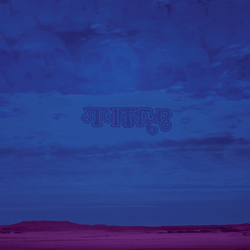
Titan—A Raining Sun of Light and Love For You and You and You (TeePee)
Titan play progressive rock stripped of all niceties and prissiness. While bands like Spock’s Beard and The Flower Kings have done their bit to keep the genre alive, their mega-polished albums and tidy chops obscure the fact that progressive rock was once underground music made on a shoestring by starving, spotty-faced lads. Where’s the scuzz? Where’s the musty cottage intrigue? Where's that creaky, overdriven sound that John Anthony got for Genesis and Van der Graaf Generator during their peak years? Titan have hitched themselves to that spirit and are plowing a wide, fetid swath across the prog landscape with it. The album opens with a short acoustic passage and a verse of warbling vocals before accelerating full-throttle into the song proper (titled "Annals of the Former World"), sounding like Black Sabbath jamming on the heaviest parts of “The Knife” or “The Musical Box.” Charge! The pace picks up and the sound's not a million miles away from the swirling, sustained freakouts that Comets On Fire reveled in on Blue Cathedral. The approach isn't overly mathy, but the band does execute some tricky runs and changeups. The second track recalls ELP at their nastiest (I'm thinking Trilogy-nasty, not Love Beach-nasty) along with the gnarly approach of Tony Williams Lifetime. The digipak sticker also references Mahavishnu, which I didn't hear initially, but it's present on this track for sure. Guitarist Josh Anzano excels with his noisemaking, but really the whole band is almost constantly going for it. They can play, no question. Dan Bates' bass tone alone is a frightening thing, and when combined with Kris D'Agostino's haunted, overdriven organ and Dave Liebowitz's drums, the chaos is beautiful to witness. There's no letup until the second track's spacey, ominous denouement. Track three begins with feedback and what sounds like throat-singing or didgeridoo before rocking out on a Hawkwind kind of feel under a blanket of phase shift. A quick gear change into a frantic 3/4 bulldoze and we're in danger of being ground up beneath the treads. Thankfully that lets up and we can remember how to breathe during the ensuing synth interlude and the segue into the final track, an insistent Can groove against a pulsing synth drone. Titan are a refreshingly rowdy take on '70s prog and its various offshoots—space rock, Kraut rock, and so on. You could probably throw in the entire Vertigo Records catalogue while you're at it. Like Zombi and Guapo, their enthusiasm for the more obscure tangents of the genre, coupled with pure instrumental bluster, has produced an album that pays homage to the past yet sounds cutting edge in this self-conscious and hidebound world.
Sunday, January 07, 2007
When I bump into people I haven't seen for a few years, they often ask if I'm still playing in a band. That's a tough question to answer because I'm doing several "things" right now, but I wouldn't really call them bands. I kind of like it that way. Every time a thing gets to the point where gigs have to be played and studio time is booked, that's when it all goes pear-shaped and I have to step back. It's self-sabotage, I guess.
Now I just mess around every weekend and get frustrated when I have nothing to show for all that banging away. But when I weigh that frustration against the utter shame and deflation of playing live and under the scrutiny of bandmates in the recording studio, I reckon I've got a good thing going right now.
And I've got friends like Greg in Edmonton, who's done up a MySpace page for DCR (stands for Dead City Radio or Dead City Rodents or Dead City Roadway or Dead City Radishes), which is the nearest thing to a band I've done in the last few years. Hearing our stuff this way is a pleasantly validating experience.
So, for everyone who's asked me if I'm on MySpace, there I am. Won't you be our friend?
Now I just mess around every weekend and get frustrated when I have nothing to show for all that banging away. But when I weigh that frustration against the utter shame and deflation of playing live and under the scrutiny of bandmates in the recording studio, I reckon I've got a good thing going right now.
And I've got friends like Greg in Edmonton, who's done up a MySpace page for DCR (stands for Dead City Radio or Dead City Rodents or Dead City Roadway or Dead City Radishes), which is the nearest thing to a band I've done in the last few years. Hearing our stuff this way is a pleasantly validating experience.
So, for everyone who's asked me if I'm on MySpace, there I am. Won't you be our friend?
Saturday, December 30, 2006

21 Tandem Repeats—Never Wanted to be Anyone (Canada Lynx)
In his efforts to promote the band, I think Super Robertson used to get frustrated trying to nail down a tidy description for 21 Tandem Repeats. What genre did they fit into? His old band, Roadbed, used to mix jazz with indie rock; now with a revamped band that includes Roadbed drummer Two Sticks Hobbs, Willingdon Black, and Alvaro Rojas, he’s injected a little folk into the mix. But is it folky enough for folkies; does it rock hard enough for rockers? In the end, he found the perfect outlet for the band: 7:30 to 8:30 every Wednesday night at the Railway Club, with the occasional “away” gig to mix things up and get in front of a new crowd. It’s good early-evening music—easy on the ears and good for any soul battered by the working day. If I had to call their music anything, I’d arm myself with a huge grain of very salty salt and suggest “tree planter rock”—amiable, groove-focused, head-bobbin’ stuff. I can hear it on a song like “Wishing Machine”—just a couple chords and a groove and a line that goes, “I’m here to get down.” Sounds like not much, I know, but Super’s scattershot sense of lyrical phrasing and the guitar touches of his latest foil, Willingdon Black, make it more than a blissed-out 4:20 jam band nodfest.
Never Wanted to be Anyone is a little slow out of the gate, with a mellow half dozen tracks highlighted by “Jupiter,” a lovely song in a novel 6/4 groove, written by Dave Hind, one of Robertson’s musical mentors. The next song, “Fuse Lit Bombs,” originally appeared in more ethereal form on 21 TR’s debut home job release the ocean is life. This version is far more “produced,” with abrupt changes in drum beats that actually make it less folky than the original. It’s still a strong number, although it’s nothing like the version you’ll hear on the previous release or at the Railway Club. “Blue Skies” is dedicated to Super’s daughter and, as befits its “hope for the future” sentiments, incorporates the sweet stylings of guest vocalist Land of Deborah.
The second half of the album is definitely more exuberant, starting with the deliberate & driving title track, on which WB asserts his presence via a lead guitar duel with himself during the song’s lengthy run-out. “Failure” really takes things into rockland, where SR’s self-deprecating lyrics butt against WB’s feisty lead guitar. Everything works here—this is how the band sounds live—as it does on “Dish Pig,” another Dave Hind song with lyrics by the late Steve Waller (to whom tribute is paid in the superbly presented liner notes). The album bows out with “Maiden,” a mold-breaking number that abandons the usual groove formula in favour of stringing together some cool parts. Top it off with vocals by Sim Special of SuperSimian fame, and it almost sounds like a different band. It’s a welcome deviation in the songwriting approach and a strong number to go out on. This album lives up to its title. 21 Tandem Repeats don’t want to be anyone (other than themselves). They’re tight, smart, and completely free of attitude or pretension. They’re through being cool. I wonder what they’re doing in the music business.
Subscribe to:
Posts (Atom)
