Showing posts with label Interviews. Show all posts

Thursday, September 18, 2008

Just skimming through Mogwai's tour diary tonight:
"Ah Vancouver, there’s nothing quite as awe-inspiring and life affirming as stepping off the tour-bus and seeing 2 people emerging from a huge dustbin. We even had a special guard to look after the bus while we were away from it."


I did a twin set of interviews for my Ascend piece in the upcoming Unrestrained! magazine. I talked to Greg Anderson first, then followed up with Gentry Densley the next day. They're both fascinating chaps in their own ways: Anderson earnest and talkative; Densley laid back and thoughtful. Densley works as a prison librarian in Salt Lake City, which is one of the greatest day jobs I've ever heard of. Anderson, of course, runs Southern Lord Records and tours the world with SUNN O))).

One of the reasons I wanted to cover Ascend was the chance to talk with Anderson about Engine Kid, his band from 1991 to '95. Engine Kid toured and released a split LP with Iceburn, Densley's jazz/hardcore outfit from the same era, but the pair's roots go back even a few years before that.

Engine Kid were a misunderstood band at the time. I remember a review of their first single, which the writer declared a Slint rip-off before smashing the record to pieces. True, the band's approach on the "Astronaut" single and Bear Catching Fish album owed a lot to Slint and Rodan. I saw them once opening for Sebadoh at the Town Pump in 1993, and I'd never heard a band play so quietly during quiet parts. The stage microphones barely picked anything up. Then they'd stomp on their pedals and bend back your ears with the incredible volume.

They quickly outgrew the obvious influences and displayed an altogether heavier and deftly dynamic sound on their next LP, Angel Wings.

And that was about it, apart from the split album with Iceburn. So when I got Anderson on the phone I wanted to ask him about his impressions of the scene at the time, and why Engine Kid sounded the way they did.

Was that era actually a good time to start a band?

"Well it’s kind of funny. We were always kind of misfits in Seattle. We started the band in '91 and we lasted till about '95 during the whole explosion and boom of the grunge scene. I liked some of those groups—Nirvana, Soundgarden, Skin Yard—I thought those bands were great, but that’s not really musically what we wanted to do. We were a lot younger than a lot of those bands too.

"The irony of Seattle is that all those bands came out of a scene that was the 21-and-over bar scene. Seattle had these really messed-up, strict laws. If you were under 21, there were just no venues and it was impossible to have an all-ages venue too because the insurance costs were so high. So all the all-ages venues closed down in the city and you basically couldn’t go see music unless it was at a huge venue, like a 2000 or 3000 seater. So as all these bands were really happening and this community was happening, we were too young to go to those shows. And by the time we were 21, and those bands had exploded and they were playing in front of thousands and thousands of people, you could go to their shows anyways! They were all ages. But at the time it was like we were more involved in the hardcore community and our tastes were diverse. We were into bands like the Melvins and stuff like that, but we really couldn’t go see them play. So we really missed out on the blossoming and the exciting time of that happening. The only band I really got to see in a small club setting back then was Nirvana, but other than that, we weren’t really a part of that. So I think Engine Kid’s sound stems from being outcasts and trying to do our own thing, even though we were taking cues from what was happening in Louisville, Kentucky with Slint and Rodan and Bastro. We weren’t trying to mimic the Stooges and Led Zeppelin. Our heads were elsewhere and our energy was elsewhere too. Engine Kid was more aggressive in some ways and eventually we splintered off into more of a metallic sound, and that was because we were just young, energetic and had a lot of aggression in what we were doing."

That isolation had some artistic benefits then…

"Yeah, again it's completely ironic because to me the whole concept of the grunge scene and all those bands coming up was based on isolation as well. It was hard to get to Seattle if you were a touring band, so we didn’t get a lot of the really cool touring bands from Los Angeles or from Chicago or from New York coming out our way because they’d basically get past San Francisco and it was kind of a dead hole. It’s a long drive to Portland, and it’s a longer drive to Seattle. So to me that was the thing with grunge, it’s like we’re going to do our own thing and we’re going to do our own bands, and that’s how they started. And ironically it trickled down also in theory to what Engine Kid was, where we just felt isolated from that as well. So it was like double isolation!"

Tuesday, August 19, 2008


“Global Metal is more of a documentary in the true sense of the word,” says Sam Dunn, “because it’s about more than just music; it’s about culture and about youth and about globalization. These are buzzwords that even the CBC loves.”

I interviewed Sam Dunn and Scot McFadyen for Unrestrained! last May, when they were in town promoting their latest documentary, Global Metal. Their visit coincided with the Rush and Iron Maiden gigs here—Dunn and McFadyen went to both shows, as they're shooting separate films about each. At the Maiden show, Dunn was actually on stage during "Heaven Can Wait," singing backup with a gang of contest winners. Lucky bugger.

It was a great kick to meet the two of them, and here are some outtakes from our interview, which took place at one of them Starbucks. (Dunn, by the way, was very impressed by the Mule Mobile, which has been my mainstay portable recorder for 25 years.)

Metallica's "Fight Fire With Fire" was a perfect choice for a theme song, seeing as kids around the world seem to have latched onto metal in response to societal or governmental oppression. How did you come to choose it, and when?

Dunn: I guess we ended A Headbanger's Journey with Metallica at Wacken, and we just kind of picked it up where we left off. "Fight Fire With Fire" is a great Metallica song. It set a template for extreme metal that continues to this day. It’s one of the first and one of the most well known that started with the acoustic guitar intro and then blasts you into this thrash metal song. And that’s something that bands are still doing to this day. So there’s somehing historically in there, but it’s mostly just picking up where we left off.

So it was more of a musical choice than a thematic choice.

Dunn: I guess. We met Lars and obviously we talked to him in Global Metal this time around. They really liked A Headbanger's Journey even though they couldn’t be in the film because they’d just finished Some Kind of Monster and were pretty burned out with cameras. He liked it enough to allow us to use "Master of Puppets" in the first one, so…

McFadyen: He was pretty awesome on this one. He found that Indonesian footage for us and sent it to us and he was like, “Don’t ever make a doc without us again.”

Dunn: I think Lars has learned that Metallica is big, but it’s not as big as the Internet. He can’t really stop it. I guess my perception of it... I mean, he’s got a bad rap because of his stance on Napster, but at the same time I think it was admirable that he was able to acknowledge [in the new movie] that this is something that is here to stay and it’s obviously something that is getting metal music to people around the world. I’m sure he would be shocked to discover that there were Saudi Arabian Metallica fans, right? I think he’s come around, which is a sign of wisdom.

Apart from your entry into China, lugging armfuls of professional film equipment through customs while on tourist visas, what were some of your hairier travel moments or experiences while traveling?

McFadyen: Our whole philosophy was that it’s better to ask for forgiveness than permission. That was the whole way we went through this. They told us not to film in Tiananmen Square. That was a big thing. And we went in there with our little 16 mm camera, just walked in and filmed the Square. 15 guards came over eventually and put their hand on the camera and we were like, "Sorry." So that’s the way we try to go through things. It’ll catch up to us one day, maybe.

Dunn: We get asked a lot, "Was it difficult getting into all these countries, and were you intimidated or scared going to all of these countries?" We actually discovered that things were safer and more open than the way we had perceived it to be. Unfortunately we didn’t get into Iran. We wanted to get into Iran because the metal scene there is pretty interesting, but we couldn’t. We went to the Desert Rock Festival [in Dubai] instead, but apart from thtat, our experience was that we were really embraced by the metal scenes and generally it was a lot safer than we expected.

We don’t look like your average TV crew or like we’re with CNN. We liked our footprint to be small. I think that’s sort of what we like about making these documentaries is that you can be mobile and try and capture something that’s a little more human, a little more ground level than what youget through CNN or major news sources.

About the segment at Blackmore’s, the Deep Purple-themed bar in Japan, where drunken businessmen screech "Highway Star" at the top of their lungs—was that a typical night there?

McFadyen: That was the second time we had been there. We went when we were doing promo for the first film—just to drink. And we were like, "This is crazy." Because the bartender looks exactly like Ritchie Blackmore. We went back and there was a few more people there. I think they’d gotten wind that we were coming and as soon as we walked in, there was a cheer.

Dunn: Something we wanted to show there is that there’s a well-known phenomenon of the salary man in japan. It’s a slang term that is for the typical hard-working Japanese businessman, and the culture there is very much that you work, work, work, work, and when you leave work you drink with your workmates. That’s where you socialize, because the work environment in Japan is very work focused. The way you actually bond with your workmates is in that environment. So we just thought it was so funny to find these guys in, of all places, a Deep Purple-dedicated bar rocking out to "Highway Star." It was just something that people had to see, because we couldn’t believe we were seeing it.

McFadyen: There’s a few moments when you're filming where you think, “This is going in the film.” That was one of them.

As Canada’s metal ambassadors, in a sense, did you hear any interesting perceptions about Canada from people you met? Who’s the best-known Canadian band?

Dunn: Well, everywhere we go and we tell people we’re Canadian, they either mention Rush or Voivod. Those are usually the first two bands that come out of people’s mouths. I think Canada has kind of come into the fore because we are so close to the United States and yet we’re recognized as being quite different...especially post 9/11. I think that as Canadians, because of the society we’ve grown up in, we’re able to look at what’s going on around the world with pretty open eyes and have a certain balanced perspective on it that maybe other countries can’t.

McFadyen: We have a pretty healthy cultural perspective as Canadians. I think that comes across in this film. It’s kind of a positive message when you think about it. All these people were pretty amazing around the world.

Dunn: Another element to this is that if we were to do Global Metal 2, Quebec would be a good candidate because it’s recognized as a home of top-quality death metal music, has been since the days of Gorguts and Obliveon and all those old bands. It has its own unique scene. And it’s interesting—the Catholic, French-speaking, much more European section of Canada became the home for metal in this country. Next to Bergen, Norway, there's more metalheads per capita in Quebec City than anywhere else.

Friday, June 29, 2007

I'm almost finished with another issue of Unrestrained! We've got some upcoming masthead shakeups that I hope will result in an even better magazine. I know I have some ideas...

For the second issue in a row I've interviewed a band that intrigued the hell out of me, only to have that band's new album get a drubbing in the reviews section. That's fine by me; I realize I'm hardly the typical U! writer or reader. The band in question last issue was Phazm, and this time it's Sleepytime Gorilla Museum.

I'm a crummy journalist; something I realized during my Voivod junket in Montreal last year, watching Martin Popoff working the room with his voice recorder. Interviews fill me with dread, although I suspect I'm getting better at them—thinking on the fly and following up on morsels of unexpected information dropped by my interviewee. The best parts about writing for U! are clicking off my tape recorder after a good chat, then (much later) clicking Send after I've finished the piece. Getting the finished magazine is cool too...just to see how my article looks. I can't actually read it again very closely. The nonsense I spew is just too painful.

I knew Nils Frykdahl of Sleepytime would be one of the good ones about a minute into the interview. He was just a staggeringly cool and articulate guy, and I'm sorry my piece couldn't have been twice as long. Here are some of the outtakes (Gorilla droppings?) from the interview.

While explaining SGM's adherence to the principles of "Rock Against Rock" (which he described as "a recognition of the need to destroy rock music in order to preserve what have been the useful elements of rock music") he mentioned that the movement had a number of historical precedents. With that in mind, I asked him if these historical precedents had anything to do with Rock In Opposition.

"I would say any movement in rock that has ambition has been a precedent. Punk rock certainly had strong elements of that. The Rock In Opposition movement was a big inspiration for us. Actually we'd been using the Rock Against Rock name for many years before knowing the name Rock In Opposition. When I discovered that I thought, 'Oh my god, wait a minute!' But I knew the groups. We were big fans of Art Bears, Henry Cow and a number of those bands before we knew that they called themselves Rock In Opposition. I think Rock In Opposition is explicitly political whereas Rock Against Rock is not explicitly political, although certainly a lot of what we’ve done has political connotations. The Rock In Opposition movement had strong ties to a European tradition of anarcho-communism, which, incidentally, we could use a dose of in the United States. Rock Against Rock is maybe more philosophical and more reckless."

Bearing in mind how amazingly dense and involved their music is, I had to ask the inevitable question about their songwriting process: what does an SGM song sound like when it’s in its “first draft” form? Is the hyper-complexity built into it from the start?

"No, not at all. Actually, that’s not true. Sometimes it is. There’s very different writing styles that are the basis for the songs. Sometimes the hyper-complexity is there from the beginning and somebody comes in with a score, essentially, and passes out parts. Dan Rathbun [bass] tends to write that way. He doesn’t typically write a lot of material, but every album has a song or two of his, and his have tended to be that way, just conceived from the ground up. My tendency has been the opposite—to come in with the most bare-bones version of a song, almost something you could sing around a campire with a guitar part and some vocal refrains or something. I’ll bring these things in and I’ll toss them out to the wolves of Sleepytime Gorilla Museum and they just get ripped apart and layered and built up until I’m saying 'Yes, yes, yes! That’s it.' So everyone writes their own parts on their very idiomatic instruments in ways that I certainly could not conceive of while I was sitting around the riverbank or wherever I was writing the song. That’s part of the process. Often those things will get built up very slowely, very rehearsal intensive, with very little going to paper. I’ll write the very minimum down to paper or one specific section that has an interlocking melodic thing that is easiest to work out on paper. Everybody is comfortable with that format, but that isn’t the way we end up working most of the time."

And then there's the video, which I hope you've all seen by now. Why did the band choose the very, very crazy “Helpless Corpses Enactment” when there were one or two more casual-audience-friendly choices on the album?

"The fellow who made the video, Adam Feinstein, chose that song. He was actually working on a video for 'The Companions.' He had the whole thing storyboarded out to the last detail, and it sounded like a really interesting video. Just as we were about to start production on that, our label, who was helping fund the whole thing, pointed out that on most video channels you can’t show anything longer than 4 and a half minutes. That song weighs in at around 10 minutes. We tried doing an edit to get it down to 4 and a half minutes, and we weren’t satisfied with it. We had just finished a mix of the Helpless Corpses song and said, 'Well, um, gee, this is a really different sounding song from that, but check this out. What do you think?' We weren’t finished with the album by a long shot at that point, so we didn’t have that many songs to choose from. So we sent him this mix of that, and he just loved it.

"Not having worked on metal stuff before and not having really listened to metal before, Adam was just excited at the idea of making a very non-metal video to a very metal song. That song is actually 6 minutes and it’s something very easy to make a 4 and a half minute version of. He immediately had all these ideas for it. He could right away picture the whole thing. Maybe someday we’ll make a little movie of 'The Companions,' but with today’s Internet-based video world you need to be able to make these little bite-sized packages, so… The video director had some strong ties with the lyrical material, to corpses. The song was—and I have to be somewhat cryptic about this—written by an Irish sorcerer, as we mention in the liner notes. He was well acquainted with that particular Irish sorcerer, so he immediately was excited about working on it. The song of course ties in lyrically very strongly with all of the other themes on the record—the themes of death and recycling of matter and rebirth and persistence of form and all those things...although it’s very hard to understand, I realize. We didn’t print the lyrics for reasons which I will have to leave undiscussed for now."

Tuesday, August 08, 2006

I'm working on my Voivod story for Unrestrained! at the moment, so I thought I'd take this opportunity to post something I've had to cut from the piece.

I got to see Voivod five times between 1990 and their final tour in 2003, and each gig holds some special memories. I think my favourite Voivod moment, though, was at their last show in Vancouver, opening for Ozzy Osbourne and (cough) Finger Eleven. It was the first show I'd seen with their new bassist Jason Newsted and the returning Snake on vocals. Even though they were playing early to a partially filled arena, they came out and killed, playing "Voivod" as their first number (the best bands have a s/t theme song—Iron Maiden, Black Sabbath, Motörhead...um...). Anyway, their playing that power-drill thrasher was the one of the most defiant, joyous things I've ever witnessed at a concert.

When I got the chance to talk to Newsted last March at the Katorz listening party, I had to ask him about that moment, and why they opened their set with that particular song. It turned out there were some very good practical reasons behind playing it.

"That’s how it was supposed to be," he said. "That’s how they did it for so long. It's just bringing it out—we’re here! That was one of the things as a band that always charmed me about them. No matter how many times you’d see them they’d either open with it or close with it. You were going to get crushed one way or the other. And especially in a situation on an Ozzfest or a thing where you’re playing with three bands like on that particular tour, you’ve got to put a song out there as the first four minutes for your mixing guy to make sure all the mikes are working and everything’s happening. We all sing on that song and all the instruments are full on and it’s got a change, the swells and everything, that gives the mixing guy a chance to go find the lower volumes, and then it crushes full on, as full volume as we’re going to go all night, so he gets to dial that in before the set starts. It’s such a racous type of song that it doesn’t really matter how shitty the sound system is, it’s still a fucking cool song because of how basic it is. So that’s really what it is. It can be in your face and raw as possible, and that’s even a better thing. Whereas if you come out with 'Astronomy Domine' [Voivod's minor-hit Pink Floyd cover] or one of your very delicate, very finessed-type songs it’ll take the mixing guy till the fourth song to get your shit together. So, that’s kind of a tactical manouver at the same time as it is this slap in the face."

Monday, June 12, 2006

So it seems that Norway's Borknagar, cosmic black metallers of some renown, have an acoustic album in the works. Sounds like a good idea to me, and I'm looking forward to hearing their swirling compositions presented in a less bombastic format. Besides, their last couple releases, Empiricism and Epic, were quite samey, and giving their sound an experimental overhaul could be exactly what they need.

Going acoustic sometimes seems like a desperate gambit for a creatively spent band, but I'm sure Borknagar aren't aiming to simply remake some "hits," giving them a radio-friendly sheen for the 18-to-35 drivetime audience. The few one-off "major departure" releases from their heavy metal peers have been credible. I thought Opeth's toned-down prog move, Damnation, was a spectacular success, while Green Carnation's The Acoustic Verses from earlier this year was a very enjoyable release.

Green Carnation are probably best known for their 60-minute concept song/album, Light of Day, Day of Darkness, an everything-but-the-kitchen-sink production that hit a number of a moods while never losing its flow or sounding anything less than grandiose. After that album, they retreated to shorter, more rocking material on Blessing In Disguise and The Quiet Offspring, before unplugging for their latest album, a project to celebrate Green Carnation's 15th year of existence. I talked to guitarist Tchort (who's been involved with Emperor, Carpathian Forest, and the ultra-heavy Blood Red Throne over the years) for Unrestrained! #30. Here's some stuff I had to whittle out of the finished article.

Do you think you'll perform any of these songs from The Acoustic Verses in electric versions? Do you think they'll change in the coming years?

I think Kjetil [Nordhus, vocals] mentioned that his song "Maybe?" was a song he originally wrote that for the full band, but then he made a different version for this album. So that one maybe will be presented later on as a full band version. But I can easily see us doing these songs during a full band live set, maybe in the middle of the set, take everything down and play some acoustic songs before continuing. We’ve been thinking a lot about how to do this in the future because we started doing a lot of acoustic shows as well. We did a couple acoustic shows in Finland with really, really good response as well. A lot of the other material like Blessing in Disguise and also stuff from The Quiet Offspring works really well in acoustic form. So it’s possible to do both separate, but it’s also possible for us to do it combined. You never know.

Do you still think about The Quiet Offspring? Will you be still going on the road to promote it?

We do play a lot from The Quiet Offspring, and we never played as many shows as we do right now. We never set up a tour for The Quiet Offspring. We did a European tour for Blessing in Disguise and that was the first tour we ever did. We were supposed to do a European tour in January and early February, but it seems our keyboard player has double booked himself with another band. I think it’s going to be split up to do long weekend shows in different countries. We do promote both The Quiet Offspring and the EP [The Burden is Mine...Alone]and the new album in every forthcoming show. We have four albums and a back catalogue that we need to promote. For example, Light of Day, Day of Darkness, people don’t want to hear a small portion of it, they want to hear the whole thing and then you end up having a three-hour setlist. That’s not always easy to work out either, so...

That's almost a special event kind of thing, isn't it?

It is. It requires a lot of equipment and so on and it’s always a big problem to bring on flights. The keyboard for this Canadian trip [to Toronto's Day of the Equinox Festival last October, where they played the entire Light of Day...] weighed 60 kilos that was 70% more than the maximum weight that Air Canada would allow, and that was just for one piece. So it was a big problem fighting at the airport just to bring it into Canada or get it out of Norway and bring it back again.

This is the first album you’ve done with your new production company, Sublife Productions. Why did you form Sublife?

Because I think that I will have different goals within the next few years. In previous years it’s been touring especially with Carpathian Forest, whom I also play with, and then there’s Blood Red Throne, whom I also tour with, and then there’s Green Carnation, whom I also tour with. I have a son at home and it’s not that easy anymore to go on the road and have 200 travel days a year, so basically I’m trying to see a little ahead, and I see myself cutting down on touring. I need to do something at home that still can be possible to combine with touring, and having a regular job doesn’t let you combine that. So I decided to form this company together with Kjetil our vocalist and basically do what I’ve been doing for the last five years, and that’s working as a booking agent/management/recording label for my other bands. Kjetil's also in Trail of Tears and another band called Chain Collector. So it’s basically doing the same thing we’ve been doing these past years but now under a specific name and just making it an official company.

Is it a way of controlling your career instead of leaving it in other people's hands?

Not really, because I don’t have problems…I have been working with a lot of great labels like The End Records, so I don’t have any problems leaving some of that responsibility with others. But it’s basically just having something to go back to when you don’t go on the road as much as you used to.

What other kinds of acts are you interested in working with and possibly signing?

We decided to go with a very local aim, meaning that we feel that bands from our area [Kristiansand] have great quality and a lot of potential, but it’s usually bands from Bergen or Oslo that people abroad know about. All the bands that you hear about in foreign magazines are Oslo bands or sometimes Bergen-located bands, but we feel that the bands where we come from have just as much potential and maybe even a greater quality to them, and we decided to focus on our own bands and tried to push some of the local bands. So you’ll be hearing from some local bands in the future and I think they have a great potential to get somewhere, of course depending a lot on the work that we do.

Thursday, May 25, 2006


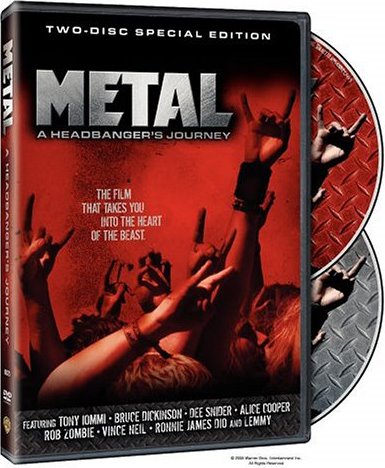
This week Metal: A Headbanger's Journey came out on DVD after a well-received theatrical run. I enjoyed this movie immensely, and I interviewed producer/director/narrator Sam Dunn for Unrestrained! Here's some material I had to cut from the article. I asked Dunn about his experience in Norway, where he filmed a segment on arson and murder-riddled Norwegian black metal scene in the early '90s, and about the fact that another film company has plans to film a docu-drama feature about those events. While the fact that Adam Parfrey (of Feral House Press, publishers of Lords of Chaos, about the rise of the satanic black metal underground) is on board as screenwriter lends some credibility to the project, metal fans will regard the movie with a lot of suspicions and cynicism.

I understand they’re filming sort of a docu-drama about the events in Norway. What do you think about that?

DUNN: "Well, I have mixed feelings about how it's going to portray what happened. I don’t know if it’s going to be purposely set in Norway, or how much they’re going to base it on real events. Who knows? We’ll see. I think it was a captivating story in a lot of ways. It’s hard for a lot of people to believe that it happened. That’s why we felt we needed to do this extra documentary [a DVD bonus segment exclusively about Norwegian black metal]. There was so much more to say than what we could say in the film. It is a part of the history of metal and certainly the anti-Christian sentiment in metal was something we wanted to cover. If we spent more than 10 or 15 minutes in Norway [in the movie proper], it would feel a little bit indulgent or unbalanced. As far as the feature film goes, we’ll see what happens. Maybe the metal community will be up in arms about it. That wouldn’t totally surprise me."

Certainly leading up to it there’s going to be a lot of cynicism.

"Absolutely, and you know what? We experienced the same thing with our film, and we still do. When we post something about the film on Blabbermouth we tend to get responses like, 'Oh my god, it’s got Slipknot and Rob Zombie in it,' and calling me a sellout. It’s amazing. You get that regardless. But thankfully people who have seen the film are chiming in and saying, 'Well, no. You know what? This film is really interesting and it’s respectful and it captures the history of this music' and stuff like that. So thank god some people are coming to our defence. (laughs)"

People are just very protective of their scene, I think.

"I think metalheads are inherently skeptical and fickle. It’s kind of part of the culture because it’s such a part of people’s identity and a part of their lives. I mean, all subcultures are kind of like that, right? It’s like a survival instinct that people have. The only way to keep it your own is to protect its boundaries, you know? (laughs)"

So now that you’ve sampled a few different lives—you’ve got your band [Burn to Black], you’re a filmmaker, you’re an anthropologist—what’s the closest thing to your heart?

"I think that I’m obsessively eclectic, so I want it all. I’m a megalomaniac in that sense. For me, I guess it's two things: we do plan to make a second film about metal that’s going to be looking at the globalization of metal and focusing on how metal has spread to very diverse countries and looking at how different religions and different cultures are affecting the music and vice versa—what this music means and how it is impacting kids in very different environments. Indonesia, Morocco, Brazil, Mexico, Russia, these kinds of countries are very diverse but all have very vibrant or budding metal scenes. I’m certainly interested in doing that, so for now another documentary on metal certainly piques my interest. For the long term I am interested in documentary filmmaking and I would like to pursue it, but I’m also applying to do my PhD starting in September. The idea is to tie that in with the next film, actually. We did feel that with Headbanger’s Journey we really only scratched the surface in terms of all the different places where metal thrives. We only went to Europe and North America, so we feel that we may have been complicit somewhat in painting the picture of metal as being a predominantly white Western phenomenon, whereas in fact it’s much broader than that. I’m really just fascinated in exploring what this music means to kids. I think it has a much more explicitly political slant in many of these countries because many of them are living in very repressive political systems and that kind of thing. Sepultura, for example, is the best known example of that."

Monday, February 13, 2006

I finished work on the new issue of Unrestrained! last week. I still feel like I'm coming up for air, as the last few days of every issue get pretty intense. I talked to Norway's Green Carnation, Toronto's Martin Popoff, and Maple Ridge's Devin Townsend for this edition, so I'll try to post some interview leftovers in the coming weeks.

I'll start with Devin Townsend, who's just released one of his finest albums ever, Synchestra, with the Devin Townsend Band. It's a homespun yet epic record, full of surprises and nonchalant genius. He's a great guy to talk to, and I regret that I couldn't include the full scope of our conversation in my U! piece, which ended up being a sort of guided tour through the songs on the new album.

I asked Devin about the guests he had on Synchestra—guests like Steve Vai, who gave Townsend one of his first big breaks as vocalist on Vai's Sex and Religion album in 1993.

You’ve got Steve Vai playing a solo on the song "Triumph." You've mentioned before that it was sort of a renewal of your creative relationship.

"Yeah, and also closing the door on a 12-year cycle. It was 12 years ago that I did that Vai thing, which kind of launched me in some peculiar directions personally and professionally. I think I spent quite a few of those years in a combination of ruing it and blaming him. I think it took me 12 years to get past that and realize the opportunity that it actually was and realizing the friend that I’ve actually got in that guy. While a lot of people had the opportunity to go to music university to learn their craft, I had the opportunity to go to 'Steve School' and learn lots about the practical application of the music, like the touring and the management end of it and the production and obviously guitar and vocals...as far into it as videos and band dynamic and all this kind of shit. Being able to apply that to my own works has shaped me in a way that it’s hard to picture myself without [all that] at this point. So having Steve perform on a song lke 'Triumph' I think lets bygones be bygones. I mean, personally Steve and I have been fine since the second year after that, but professionally I’ve just been going down so many weird paths for so long that to get out of that cycle by having him appear on the record is really therapeutic."

Did you have any specific instructions for him on the song or did you just say "Go ahead and do your thing"?

"Yeah, the only specific instruction I had was 'Here’s the file—rock it.'"

There’s a female vocalist on the album too. Who is that?

"Well, Nick Tyzio is our sound man. He’s been our sound guy for Strapping Young Lad for a while now, and he’s a really good sound man and a really good guy. Because Synchestra has a pretty family-oriented theme to it I tried to find people who were within our circle, and Deborah is Nick’s wife. She’s got a really good voice and she’s got a lot of things that she’ll be doing in the future. She’s really talented, so it was good to be able to utilize her voice for this."

Monday, November 28, 2005

I’ve probably mentioned this before, but a lot of the new bands I like are the musical equivalent of those societies for creative anachronism…you know, where librarians and computer programmers trade recipes for mead, don homemade chain mail vests, and have a bit of a joust on the weekend. Certain musicians take a similar approach to music, buying up old equipment and recording in analog to achieve their own vision of rock’s medieval period (i.e. 1974). Go to it, I say.

Norway's Wobbler are definitely of this ilk—a band desperate to be not of their time. As far as I can gather, lead guy and keyboardist Lars Fredrik Frøislie was born in 1982, for chrissake (the year that marked the official death of progressive rock with the release of the first Asia album), yet he’s buying up barnfuls of vintage keyboards and writing florid-yet-menacing 27-minute epics like the post-hippy brave new world is at hand. The songwriting on their Laser’s Edge debut Hinterland is wild and wooly for sure—reflecting more of an influence from the restless Italian bands than the more stately British prog originators—with only differing elapsed time to distinguish the three main tracks on the album. Despite that lack of discipline, I’ve gotten a huge kick out of Hinterland, probably because I was around in 1982, head in hands as “Heat of the Moment” oozed from the radio. Having survived that experience, I’ll always have time for the Wobblers of the world.

When I did an email interview with Frøislie for the next Unrestrained!, I had to ask him about his arsenal of vintage gear. Which keyboard is his prize possession?

“I guess it would be my first Mellotron M400, serial number 1652 from 1976. It has never let me down to this day. I got it from the national radio in Bulgaria along with about a dozen other vintage keyboards. I basically bought the old prog band Formation Studio Balkanton’s studio. It was converting into a folk rock studio, so the keyboards were just in the way.”

Whereas a lot of keyboard players chicken out and use digital keyboards with patches and samples on stage, Lars goes for the full Rick Wakeman, bolstered perhaps by one of those backbraces favoured by Home Depot employees.

“On the last concerts I’ve had a Hammond C3 with Leslie 122, two Mellotrons, MiniMoog, Arp Pro Soloist, Roland Ep-10, Clavinet and Rhodes. It was hell lifting and setting up, and we used my father’s truck without any roof (thank God it didn’t rain), since it was the only one large enough.”

So do Wobbler and White Willow (whom Froislie also plays with) have the Norwegian prog scene all to themselves, or are there any other bands we should know about?

“It has been growing over the last few years. Prog rock has almost been accepted in the media in Norway, so it’s not as uncool as when we started up. There are not that many symphonic prog bands like us, but there’s Anti-Depressive Delivery (heavy rock/metal prog), Circles End (Canterbury/pop), Panzerpappa (RIO) and Gargamel (retro).”

Tuesday, August 09, 2005

This entry arises partially out of the need to fill some column inches and tamp the Bee Gees down, out of your line of sight.

I just finished working on the new issue of Unrestrained! (should be out by the end of August). In addition to the copyediting, I did three stories for #28—Circus Maximus (righteous Norwegian prog-metal, just the way blacknblues likes it), Frameshift (in which we learn of the dangers of hiring Sebastian Bach to sing your concept album about human tendencies towards violence), and Presto Ballet.

For the last piece I talked to Kurdt Vanderhoof, who wrote all the music for the project in between his main gig with Metal Church. Presto Ballet is a riotous take on seventies American pomp-prog—sort of a cheekily grand illusion of The Grand Illusion. Twenty-five years ago it would have been all over the radio, which is mildly interesting to ponder, but that kind of hypothetical crap doesn’t help Vanderhoof’s cause. He’s not worried about airplay anyway; he’s just enjoying working in his studio and being the old-school rock guy.

Here are some bits I transcribed but had to cut out of the article.

[ME] Do you still have to sacrifice as much as you used to in order to play music?

[KV] Oh, absolutely—any kind of stability, any kind of relationship, any kind of money. I’m still pretty much living the way I was when I was 19…which gets a little bit old, but you get used to it.

You’re a big fan and advocate of analog sounds and analog recording. Does it freak you out that they’re not manufacturing recording tape anymore?

Uh-huh.

Where’s it going to come from?

They’re still manufacturing it, but the bigger companies aren’t doing it as much. It’s more boutique now. Smaller companies are still making it, because most of the major industry studios and producers and stuff still want analog tape. There’s definitely still a market for it, but it’s not enough of a market to keep the big companies going, like Quantegy, Ampex, and BASF. There’s not enough recording studios, because most of us who work in the studio or own studios, the demo market is completely gone because people, instead of spending $3000 to make a good demo, they just go spend $3000 and buy themselves a digital rig for home. They don’t go spend the time in the studio. The big studios are almost all gone unless you’re a major, major studio. But for the rest of us, you can still buy tape, although the big companies quit making it. I just found this out about six weeks ago; you can still get tape. It’s a little more expensive and you have to really know where to go look. You can’t just go buy it like you used to. Tape sounds better and everybody knows it.

So obviously your studio is equipped with a tape deck.

Yeah, two-inch tape, exactly.

Have you made any concessions to computer recording?

Yeah, I have my own digital rig here in my house and I do my writing on it, which is fantastic for the creation process. I’ll totally give digital the tip of the hat in that respect, for the writing, but for actually putting out finished products, it still sounds like crap. It’s a great tool for the creation process. Sitting in front of my computer, the shit you can do is amazing, but it’s nothing that I would ever use to put out a finished product. It’s just for coming up with the ideas. The cut-and-paste editing is just amazing to try new arrangements, and it sounds good, but it doesn’t sound like a record. It beats the hell out of the old cassette four track.