Showing posts with label Album Reviews T–Z. Show all posts
Showing posts with label Album Reviews T–Z. Show all posts
Tuesday, November 15, 2016
Thumbscrew—Convallaria (Cuneiform, 2016)

Saturday, November 22, 2014
Yob—Clearing the Path to Ascend (Neurot)

The newest release from the legendary
Oregonian doom trio turns out to be the most open and expansive Yob album. With
only four songs, it originally struck me as a very long EP. I felt during the
first few listens that it might have lacked enough content to make for a
satisfying 62 minutes. I still can’t shake that notion; however, Clearing the
Path to Ascend just needs to breathe and be whatever it wants to be. Not
forcing things is what Yob’s all about. In a way, they’re saying more by
saying less. “In Our Blood” eases us into the album with a mere 17 minutes of
everything that makes Yob great: lumbering riffs rippling with complex
overtones, downward shifts into sparse strumming and shock-cut volume
dynamics—the whole whisper-to-a-roar gambit. “Nothing to Win” almost takes the
form of a conventional rock song with its tense-verse-and-cathartic-chorus
structure. That impression is undone, of course, by the dissolution of all that
during the song’s second half. But man, does it build to a huge finish. The
song highlights the album’s murky production—it’s not bad or detrimental to the
material; it’s just such an onslaught of competing tones. That element of the
Yob aesthetic hasn’t changed. The drums fight to get through beneath the
mattress pile of guitars, which is always threatening to collapse and smother
you for good. The last track is really something magical, and it’s the one I’ve
had to work hardest to change my perspective on. At first “Marrow” seemed
bloated—a nearly 19-minute song made from about 8 minutes of material. There’s
no question that it’s a beautiful set of chords with an affecting melody
overtop. Mike Scheidt sings his heart out on it. Moodwise, it feels like a
heavy ballad from the ’70s in the tradition of “Here Again” by Rush, “Parents”
by Budgie, or Zep’s “No Quarter”. Those bands managed to say their piece in the
space of 7 to 10 minutes; why couldn't Yob? Damn modern bands and their lack of
self-editing. But “Marrow” develops beautifully and it does have enough content
for what would have been a side-long epic back in olden times. It’s the most
graceful song they’ve recorded, and when I hear the first few notes ring out, I
know that I’m in for one of the year’s best pieces of music.
Thursday, October 30, 2014
Z—Visions of Dune (InFiné)

Based on the liner notes for this album, Bernard Szajner (aka Z) sounds like an all-round genius—a visual artist, musician, inventor,
and engineer. As the creator of light shows for Euro-prog outfits like Gong and
Magma, he specialized in transforming sound to image. With Visions of Dune, originally released in 1979, the transformation is
reversed: Szajner’s own visions of Frank Herbert’s universe are translated into
sound. The sounds themselves are quite spectacular. Szajner bases everything on
his all-powerful synthesizers, and employs a team of guest musicians to fill
out the picture with guitar, bass and drums. It’s planetarium music for sure,
but unruly and unsettling enough to plunge into some truly dark matter. Z’s cosmos
is not necessarily a harmonious, friendly environment. The tracks are
relatively short for this kind of exploratory music, especially compared to
Tangerine Dream or Klaus Schulze’s side-long excursions. However, they often crossfade
to provide seamless stretches of listening. The drones and sweeps of “Dune” are
like an approaching wall of fog that give way to the percolating sequences of
“Bashar” and the following tracks. Drums enter the picture on “Bashar” and
“Fremen” to lay down a funky beat. The chaos and overlapping elements remind me
of Heldon’s anarchic approach. The feeling of barely reined-in circuitry is
very similar. Who’s winning—man or machine? The mp3 download included with the
vinyl adds two bonus tracks that were originally left off the album for being
“too futuristic.” Indeed, the moaning, scraping bleakness of “The Duke” and
droning menace of “Spice” are interesting diversions from the main programme. Jodorowsky
shouldn’t have bothered trying to cajole Pink Floyd into making the soundtrack
for his own vision of Dune. If he’d
waited long enough, he might have stumbled on this music instead. I’m betting
Jodorowsky and Szajner would have been a good match. This album is a brave new
world to discover, even 35 years after the fact.
Friday, September 14, 2012
Jeff Younger’s Devil Loops—volume two (jeffyounger.net)

We last heard from our Jeff when he
released the debut from his jazz colossus The Unsupervised. Since then he’s
focused on solo work and a summer tour across the country doing workshops and
gigs with his Devil Loops project. In May this year, he took off to the Okanagan to record volume two over a couple days (I reviewed volume one here). The six tracks represent six
performances of six spontaneous compositions—no overdubs or editing, as he
points out in the album notes. As such, the sounds are abstract and elongated,
with Younger allowing himself to harness any sound that
the guitar might possibly make. Interestingly, he doesn’t use any overtly "spacey" effects such as chorus or flanging; he's cooked up his own special sauce of loop/delay, pitch shifting and volume pedals, and some distortion and reverb. Cavernous drones, cosmic reverberations, industrial
scrapings, video game bleepblorps, and tiny insect noises fade in, mingle, then
fade away. There’s even some passages that feature recognizable “guitar
playing” where you think, “Oh, I bet this guy plays jazz,” especially on
“Roomies,” where gentle guitar lines tumble over each other, always threatening
to align without ever doing so, with beautiful results. Overall, it’s a surreal and often soothing
listen that reminds me of early Cluster or Tangerine Dream—not that I’d pin any
of those influences on a self-directed, schooled musician like Jeff Younger, but you know,
if you're into the German ambient spacenoise, you might get into this. In
less-considerate hands, such freedom and minimalism could devolve into some
sadistic feedback assault, but Younger’s approach is much more inviting. This
edition of Devil Loops paints an intimate soundworld that ducks away from big
gestures and grand climaxes. For such an uncompromising, gutsy endeavour, it
has a generous soul.
Thursday, November 03, 2011
YOB—Atma (Profound Lore)
 2009’s The Great Cessation was a stern, angry album that signalled YOB’s tumultuous rebirth after a period of label-imposed strife for mainman Mike S. Although Atma is another forbidding record, the band sounds at relative peace. The songs don’t dip quite so deeply into the abyss and the riffs sing out a little more. While the “doom” tag fits, I think their music encompasses much more. To me, doom entails some connection to rock & roll and the blues—you know, Black Sabbath and stuff. YOB’s music doesn’t look backwards. It looks within. It’s grim and monolithic, residing closer to Neurosis than, say, Candlemass.
Mike S. is a one-man guitar army deploying an orchestrated barrage of tones. He’s one of the most accomplished and distinctive guitarists in metal. He can riff relentlessly, piling on variation after variation, as he does on the first seven minutes of “Before We Dreamed of Two” before a classic calm-before-the-storm section with guest Scott Kelly takes over. His guitar is also a punitive instrument, as on the title track, where imposing riffs lead to a long stretch of unaccompanied one-note palm muting from which the climactic riff erupts. The power coming off those tortured strings is intimidating.
There’s usually at least one song per YOB album that swings a bit, like “Quantum Mystic” from The Unreal Never Lived. It took a couple listens to pinpoint it on Atma. Opening track “Prepare the Ground” is the one, though. It swings inexorably; it's a testament to the band's discipline that they managed to hold back and avoid giving it more of a "boogie" feel. “Adrift in the Ocean”—my favourite song on the album—features the tranquil side of YOB, opening with two and a half minutes of atmospheric guitar picking before blasting off for 11 exhilarating minutes that blend crushing guitars and strong vocal melodies. Mike S. uses his upper register—a mutant Burke Shelley/Geddy Lee yowl that’s always been one of YOB’s most appealing elements to me—more than he has since Catharsis.
The production is hideous but effective. The guitars are smothered with pillows, while the drums are brittle and papery. It actually sounds better through earbuds than on my stereo at apartment volume. Cranking it to move some air would help, I’m sure. It’s got character though, and does not hinder the power of YOB one bit. As history has proved, nothing can stop this band. They possess enough inspiration and soul to prevail every time they head into the studio. The chorus of "Prepare the Ground" sums up their attitude (and it's a notion I need to apply to my own life): "Breathe in the power of no tomorrow."
Wednesday, October 12, 2011
The Unsupervised—Elevator
 I’ve seen The Unsupervised more than any other band over the last few years. It’s always a treat heading downtown on a Saturday night, dodging all the wannabe Snookis and quasi-Situations on Granville Street, and ducking down an alleyway to find a quiet room in which to see The Unsupervised rip it up in the company of five or six other fans.
 Of all Jeff Younger’s projects—I’ve reviewed The Nudger and Devil Loops here—he’s been pushing The Unsupervised the hardest of late. As well he should; they’re a pretty complete package—an irreverent jazz band that can get funky and complex/proggy. Their approach reminds me of Led Bib, albeit a little more polite; Canadian, if you will. This recording, made to accompany their summer tour, collects their prime material. Although you really need to see The Unsupervised live, Elevator is a nice souvenir, with six action-packed pieces that stand up effortlessly away from the stage.
Although he’s The Unsupervised’s composer/supervisor, guitarist Younger hangs back for the most part, letting the rhythm section (Ben Brown, drums; Russell Sholberg, bass) and horns (Kristian Naso, trumpet; Colin Maskell, sax) duke it out.
He does turn it up on “Sandalfoot,” a funky tune with some heavy (for jazz) powerchord breakdowns and riffs avec distortion. Overall, the songs swing between freewheeling sections and composed, disciplined passages. There are enough tight, syncopated unison parts to keep any math rocker on his/her toes. How the band keeps on top of it all I’ll never know, but then again I’m not as musically edumacated as them.
Each track highlights a different strength or aspect of The Unsupervised’s approach. “Inches” is a stellar showcase for drummer Ben Brown, giving him lots of space to flit around as the rest of the band provides commentary in the form of unison stabs and swells overtop. “Kornatta Glanke,” the longest track, opens abstractly with the rhythm section scrabbling around the attic before being displaced by whimpering horns, then Younger takes a solo turn, gradually leading the band into the main theme five minutes into the 10-minute piece. There’s a staccato ensemble section, a lengthy sax solo over churning 5/4 chords before it all comes home with a staccato reprise. It sums up everything The Unsupervised are about—a jazzy cornucopia of heady goodness.
Thursday, May 05, 2011
21 Tandem Repeats—One Little Dream (Canada Lynx)
 Super Robertson is his own man, and he does what he does with no concern about what’s cool and what might "rock." We should all be so unencumbered by cultural baggage. If this makes him an outsider, never mind; he’s got larger concerns. He’s got kids to raise, a Supper Show to organize every week, a garden to tend, bee survival to worry about, and songs to write.
Dreams have become a theme in his work as 21 Tandem Repeats. On “Robertson’s Dream Orchard” (from No Junk Mail Please) he sang about a fantasy of small-town life amongst the trees and bees. He expresses the same urge to escape the city on “Bold Point Road,” where he once “went to learn about the farming life” on Quadra Island. “One Little Dream” is about having the spirit required to help that dream survive in the face of challenges to our creativity and growth—“You gotta be bad to be good.” As ever, Super’s got ideas and opinions packaged up in these dreams-turned-songs.
With his last album, I gave him some stick over what I thought were less-than-definitive versions of songs that I’d been enjoying live. Timid arrangements diminished the material, I thought. This time, he’s assembled a crack team that has injected a lot of style and personality into the album. Alvaro Rojas (Cortez the Killer, Big Buck, etc.) and Willingdon Black handle electric guitars, adding twang and raunch when required; Johnny Wildkat (Mongoose) plays bass; Shawn Killaly—an irrepressible showman and incredible musician—is on drums, cracking the whip and giving the songs a boot up the arse. The MVP trophy, though, might have to go to C.S. Rippin for his piano playing, always rollicking away in the background, providing bounce and some humour—do I hear “Sweet Home Alabama” licks in “The Last Honey and Toast”? Jesse Gander’s mix buffs it till it sparkles. It’s a great leap beyond 21 TR’s handmade origins.
Quirks and characters populate 21 TR’s folk music. A song about a photographer friend (“Moustache Man” ) leads to a tune musing on Robertson's own neighbhourhood notoriety (“Famous Person”), followed by a slice of road-trip life from Robertson’s Knocking Dog days (“I was thinking that this ought to be in a movie” he thinks, as they drive through “Saskatchewan”). A minor gardening accident inspires “Rage Hero Episode #37,” a rambling narrative that Genny Trigo sings with the rage-negating chipperness of a children’s entertainer. Best of all, though, is “Nothing is Heard” a protest song that reminds me of Neil Young whipping up a storm with Crazy Horse. This version far eclipses what I’ve heard on stage. Based on this song alone, I’d declare One Little Dream a success, but considering everything else—the fine playing, the production, and other songs like “The Recurring Hurrah” and the title track—it’s clearly the best 21TR effort yet.
Thursday, October 07, 2010
Zevious—After the Air Raid (Cuneiform)
 Zevious are “way out” and “too much.” The trio slips me a mickey on “Where’s the Captain?,” opening the album with a skittering bit of electric jazz. Just as I’m settling back for a John McLaughlin Extrapolation-style outing, they shut her down and burst into some powerful, angular King Crimson/Voivod damage. Then the madness escalates as the song breaks into detailed micro-skronk sections that remind me of Dysrhythmia or Behold...The Arctopus. Looking at the personnel involved, all this makes sense—Dysrhythmia’s Jeff Eber plays drums (joined by brother Mike on guitar), and the album was recorded by Colin Marston of Dysrhythmia, Arctopus, and Krallice. Zevious represents a jazzier take on the tech/math/prog thing. They’re tight, but the tones they employ are occasionally mellow. Bassist Johnny DeBlase plays both electric and upright, and Mike Eber operates in a slightly distorted middle ground, only cranking it up when absolutely necessary. He offers the strongest contrasts on “The Children and the Rats,” shifting between gentle picking and sudden, atonal squalls. Amongst all the riffs and motion-sickness rhythms they make space for lots of guitar solos and a couple drum spotlights on “iNCITING” and “Glass Tables.” The guitar solos are when Zevious loosens up and takes off—it’s great to hear the rhythm section churning away while the guitar clears a path of its own. I’ll admit to feeling worn down by the second half of this album, such is the jazz battering they dish out. But the more I listen to After the Air Raid, the easier it gets to absorb it a single pass. McLaughlin, Williams and Pastorius may have tried it first, but Zevious are a trio of doom for today.
Friday, May 14, 2010
Triptykon—Eparistera Daimones (Century Media/PDR)
 Born from pain and steeped in death, Triptykon has roared to life. Triptykon is Tom G “Warrior” Fischer’s new project following the ugly demise of Celtic Frost only one album into their comeback. Monotheist, the comeback album in question, brought them much acclaim (it was Terrorizer's album of the year), but to me it offered little of the raw, elemental riff satisfaction of classic Celtic Frost; only hyper-compressed sound smears and cringe-worthy attempts to out-extreme Celtic Frost’s blackened disciples. I pulled Monotheist out for another listen just before Triptykon’s release date, and it was still a miserable experience.
I checked out some Triptykon material online and read the advance reviews. Buying the thing still felt like a small act of faith...one that was rewarded. With Martin Ain and the drummer purged from the lineup, Triptykon have written actual heavy metal songs rather than trying to scare the bejeezus out of us. Eparistera Daimones is more down to earth, despite that fancy title. Like Monotheist, it’s ridiculously down-tuned, but there are riffs, clearly delineated sections, and quick shifts in tempo—the building blocks of memorable songs. The ill-logic of classic Celtic Frost prevails.
The album’s first 11 minutes whizzes by as “Goetia” unleashes a barrage of colossal riffage. Again on the similarly hefty “Abyss Within My Soul” and “In Shrouds Decayed,” the riffs do most of the work. The song structures will be familiar to anyone raised on heavy metal in the ’80s. Remember when metal songs had “thrash parts” and you’d anticipate the final sprint on songs like “No Remorse” or “At Dawn They Sleep”? That’s what “Descendant” does, and it sure made me smile. For out-and-out thrash, there’s “A Thousand Lies” which should have a Speed Metal logo slapped on it.
The inevitable genre experiments and diversions come late in the album. “Myopic Empire” bogs things down a bit; a B-side quality song with a piano interlude inserted in the middle. Neither element is very compelling. “My Pain” continues the exploration in a Massive Attack or Anathema mode, yet it’s not bad, barring some clunky spoken word passages. The album bows out with “The Prolonging”—a 20 minute mass of deformity pulled from the same agony bag as much of Monotheist; occasionally headbangable, but mainly a thing of ghastly wonder.
The angst-ridden vocals are up front and discernable, to their detriment. I’ll always prefer the cryptic, garbled approach that rendered songs like “Jewel Throne” so mysterious. (My reissue of To Mega Therion has lyrics, but I’ve avoided looking at them.) Warrior has transcribed the frustration of the last few years too literally at times (“You betrayed me to my face,” “As you perish, I shall live,” and so on), resulting in vindictive tirades a far cry from the mystique of old Frost. But stripping away that mystique seems to be Warrior’s mindset these days—see also his often painfully revealing book on the Hellhammer years, Only Death is Real. Anger and revenge inspired Warrior to form Triptykon and release a far better album than Monotheist. I can't argue with the results.
Friday, March 19, 2010
YØGA—Megafauna (Holy Mountain)
 YØGA deal in pure sound, delivered in bursts of confusion and terror. The duo of Vatten Häst and Eld Anka don't give us much to go on, aside from the sound. The credits in the CD are minimal: no producer, no studio, no equipment lists, no thank yous to everyone they met on the road. Obscurity adds to the intrigue. Megafauna comprises 12 roiling vortexes of synths, guitars, drums and noise, swirling with soot and scattering debris across fields of sonic loathing. It’s like Darkthrone lighting incense and blissing out with Popol Vuh, with Kevin Shields mixing the results. The song titles reference a flying witch, the hidden people, a treeman, a warrior, the dreaded chupacabra. YØGA drag us down onto the mouldy earth, cowering from misshapen things glimpsed amidst the trees. Sometimes a riff works its way up from the mire—the martial doom theme of “Treeman” is especially strong—but when it does, the atmospheres over top threaten to snuff it out. No clean sounds exist on Megafauna. Everything is filthy, perverted beyond its natural resonance and oscillating out of control. Each track is its own little world—all fearful, haunted places—and the flow within each one demonstrates YØGA’s consideration for composition. Chaos resides on the surface, yet all is controlled inside. Sick minds are clearly at work, and I hope they're well stocked with ideas. I want to hear where they go next.
Friday, December 18, 2009
Woods of Ypres—Woods 4: The Green Album (Practical Art)
 Woods of Ypres do things that metal bands are not supposed to do. Head songwriter David Gold writes in the first person, but doesn't indulge in any role playing. He battles inner demons, not supernatural entities. The lyrics encompass vulnerability and longing as well as anger—the latter arises out of the former. Musically, Woods tackles several genres within a single album, which is refreshing in a time when bands rewrite the same song 10 times and call it an album.
Woods 4 includes some "Peaceville 3"-style doom, some melodic, mid-paced Katatonia/Amorphis rockers, some orchestrated piano-and-strings sections, some blasting BM and DM bits, and a couple hammer-headed sludge tunes. So although the band's PR material labels their sound as black and doom, listeners looking for an earful of one or the other will come away unfulfilled. But for those who want variety and regard scene policing with contempt, Woods have delivered another enjoyable and highly successful album.
Thematically, the album that Woods 4 most reminds me of is Marillion’s Misplaced Childhood. Both albums begin with the death of a relationship and chronicle the personal journey that follows. In Marillion’s case, vocalist Fish loses himself in backstage debauchery and in various identity crises provoked by the touring life. For David Gold, the post-breakup journey is just that: he takes an opportunity to travel abroad (“Dive into exile!” as “Dirty Window of Opportunity” puts it), and deals with isolation and regret while finding a new life in South Korea.
Musically the band covers more ground than ever. The variety of the material is necessary to sustain the listener’s interest for a 78-minute album. The sequencing of songs helps as well. There are breaks between tracks (unlike Misplaced Childhood), but after a few listens to the entire album, I started hearing the songs as a series of suites. The opening of the album is consumed with gloom and sadness, and the tempos reflect this. The doom is quite My Dying Bridal on “Everything I Touch Turns to Gold (then to coal)”, with Gold's “whoa-oh-oh”s standing in for MDB’s violin lines. The opening movement ends with “I Was Buried in Mount Pleasant Cemetery" (Gold’s favourite titling theme has a rhyming scheme) and the narrator's figurative death before he assumes a new identity as a single man in a foreign land. The most intriguing stretch of songs lies at the heart of the running order, from “Wet Leather” (the album's most immediately catchy song), “Suicide Cargoload” and “Halves and Quarters” (two brief but heavy rockers) and “You Are Here With Me (in this sequence of dreams)” a lullaby/lament with instrumentation by Musk Ox. This is where the album's depth and variety is really evident.
With all this going on, the album works it way from the personal to the universal, from the opening scene of a breakup to the closing track’s call for a tenuous truce between sexes: “Women move on. Men move on.” Tellingly, this is where the voice switching to the 2nd person, as if to impart some hard-fought wisdom to the listener. This song—"Move On! (the woman will always leave the man)"—also invokes the seasons, a nice reference to the themes from previous Woods releases.
Woods of Ypres have outdone themselves with this album, and again have demonstrated that metal doesn't have to be purely a vehicle for escapism. The plain-spoken nature of Gold's lyrics might throw some people off, but for me, Gold's words and images paint vivid, precise pictures. Each song is like a heavy metal Alex Colville painting, a scene revealed in unforgiving, relentless light.
Thursday, December 10, 2009
Bedlam from Belgium
A lot of the music I listen to comes from a dark place. I’ll lap up the guttural, gut-bursting fury of Suffocation, the blood-caked emotion of Neurosis, or Deathspell Omega’s dissonant, Dantean hymns and gladly return for more. But when it comes to true Musica in Diabolus, none of them are fit to touch the grim robes of legendary Belgian chamber rock/Rock In Opposition bands Univers Zero and Present. A lot of prog bands describe graceful arcs with their music. The Belgians slash and stab, grind and jab. I have no idea how music like this gets made. Sacrifice, poverty and hunger play a large role, I’m sure...plus a buttload of rehearsal. Why doesn’t every kid who’s forced into piano lessons just flip out at age 17 and start making music like this? If I was a bitter child prodigy, with classical chops and a hate-on for mumsy and papa, that’s where I would have gone.
Univers Zero is led by drummer Daniel Denis; Present’s leader is guitarist Roger Trigaux, who was in Univers Zero for their first two albums. Each band reflects its leader’s instrument. Univers Zero’s music is abrupt and choppy, with riffs that sound like they’re based on drum rudiments. Present trolls similar dank, stony chambers, with the guitars of Roger Trigaux and his son Reginald providing additional menace. Both bands have monster drummers. In a genre where the standard was set by Christian Vander and Magma, it’s a must. Denis (who actually joined Magma briefly in the early ’70s) combines a free-flying Art Blakey and Keith Moon approach with a classical percussionist's discipline. Present’s Dave Kerman hits even harder—he’s a big fan of Gaza and other types of grind madness—yet he matches Denis’s orchestral approach in playing the entire kit at all times.
Univers Zero—Relaps: Archives 1984–1986 (Cuneiform)

Relaps collects Univers Zero live recordings from a difficult time in the band’s history, as documented in the liner notes. Although line-up changes and financial woes put the band’s existence in jeopardy, the eight tracks featured are bombastic and fierce—the sound of a band driven to survive by destroying all comers. For the sake of my nervous system, I hope I don’t hear anything more intense than the version of “The Funeral Plain” heard here. The extended ostinado solo section that sees Jean-Luc Plouvier and his demented DX7 work handing off to Michel Delory’s equally sadistic guitar solo is audio terrorism at its finest. It’s surprising to hear the audience applauding at the end, and realize that UZ hadn’t rendered the crowd into clumps of bubbling goo at Belgium’s Centre Culturel de Seraing that night. Some people evidently survived.
After this period and a final studio album (Heatwave), Denis retired the band until 1999's The Hard Quest.

Univers Zero: Evil Incarnate
Present—Barbaro (ma non troppo) (Ad Hoc)

Present took a similar path to UZ, releasing two albums in the early ‘80s before resurfacing with Certitudes in 1998. Their latest, Barbaro (ma non troppo), is a two disc set comprising three new studio recordings (44 minutes) and a DVD with nearly three hours of performances from 1994 to 2007. The new music is stunning. “Vertiges” is a 16-minute labyrinth of percussive insanity—pianist Pierre Chevalier hammers the piano like a man possessed—that builds to a couple climaxes. You might think they’ve given everything they had at the 9:30 mark, but wait, there's more to come. Chevalier’s “A Last Drop” has more of a sustained groove—albeit an off-kilter, juddering sort of groove—before it drops into a tension-building section that almost sounds pleasant and achievable by mere mortals. The final track is a little bit special in that it’s a remake of Trigaux and Denis’ “Jack the Ripper” from Univers Zero’s malevolent 1979 masterwork, Heresie. The older version was shrouded in the murk of a London fog; this new one gleams and flashes like a knife blade.
The DVD portion is just as alarming. The primary footage is well shot and edited, with the musicians’ craft as the main focus. Present in concert isn’t a heads-down noodle-fest, though. They do have a flair for the theatric. Witness the stern, gaunt figure of Roger Trigaux conducting the band through the first half of “Promenade au fond d’un Canal” like he’s casting spells. Cringe at the shirtless war-painted guy who takes centre stage to pound out time on a pipe. Thrill to Trigaux smashing his guitar at the end of “Promenade...” from a seated position, no less. Chuckle at the world’s unhappiest teenage girl sulking in the front row at the Gouveia Art Rock Festival in Portugal. Wonder at the sight of Kerman playing the drums with wooden spoons, chains, and Barbie dolls at various points. The highlight comes when the Barbie heads eventually come flying off and Kerman continues smashing the cymbals with the decapitated doll bodies. It’s official: Present are the most brutal band ever.
Wednesday, September 23, 2009
YOB—The Great Cessation (Profound Lore)
 Mike Scheidt and his latest YOB mob (old drummer Travis Foster and new bassist Aaron Rieseberg) have come roaring back to life after Scheidt’s disastrous turn with Middian, the project he started after folding YOB. Middian released the fine Age Eternal album, then were quickly sued out of existence by a band who owned nearly the same name. To add insult to injury, Middian were designated as “untouchables” and dropped by an unhelpful Metal Blade Records. Considering what Scheidt has been through, it’s tempting to hear the new YOB album as a prolonged howl of anguish. However, The Great Cessation is not mere catharsis; it’s a defiant and triumphant continuation of where YOB left off with 2005’s The Unreal Never Lived. America’s finest doom act is back, and stomping balls. As guitarist and vocalist, Scheidt holds the keys to YOB’s sound. He’s always been a tasteful guitarist, even when pounding out waves of sludge cranked up beyond 11. Engineer/co-producer Sanford Parker knows how to record this sort of thing. The guitar tracks are massive, and Scheidt has more than just a few powerchords in his guitar-senal. He hits all six strings, sending you whirling helplessly in a tornado of frequencies. “Burning the Altar” is a thundering opener, full of YOB trademarks such as Scheidt’s alternating high-pitched/monster growl vocals, sluggish pacing, and an epic length that encompasses a Middle-Eastern-flavoured interlude and a squalling guitar solo to take us out. “The Lie That is Sin” is melodic and surging, demonstrating the power of control and restraint. The only track that resists enjoyment is “Silence of Heaven,” a cauldron of torment that divides the album in half. The layers of hellacious vocals overpower the music’s grinding doom, throwing the balance off. I couldn’t make a breakthrough on this one; it doth not rock. The 20-minute title track, the best song on here, is perfectly paced and perfectly placedas an album closer. It opens in an archetypal post-rock style, a desolate crawl with murmured vocals. As a song, it flows perfectly, never dragging, expertly assembling a few crushing riffs, while avoiding extraneous repetition or digressions. On this track you can hear YOB’s music getting leaner and more holistic; the joins becoming more difficult to discern. Scheidt’s portentous strumming conveys immense melancholy, as do the lyrics: “Will we ever see a time without cause, when we see what we know never was?” This kind of wistfulness in music and lyrics elevates YOB above other Sabbath-worshipping doom acts. YOB could cover “Cortez the Killer” as credibly as “Hand of Doom.”
Tuesday, June 02, 2009
Steven Wilson—Insurgentes (kscope)
 No one’s straying outside their comfort zone on Insurgentes—neither Steven Wilson or his audience. If you like Porcupine Tree’s recent output, then you’ll be more than happy with what is billed as Wilson’s first solo album (ignoring the fact that he oversees everything to do with Porcupine Tree, which started as Wilson’s one-man project). While the sounds and atmosphere on Insurgentes haven’t fallen far from the Tree, differences emerge with repeated listens. The album has given Wilson the chance to work with different musicians (including Tony Levin, Jordan Rudess, and Clodagh Simonds from Mellow Candle). PT drummer Gavin Harrison plays on nearly every track. Every time you think the album is going to settle into an intimacy typical of a solo album, Wilson throws in something to subvert it and take a song in an unexpected direction. Even a fragile little song like “Abandoner” is host to a series of what must have been painstakingly constructed textures. Likewise, the plain piano and voice format of “Get What You Deserve” is eventually consumed by crashing guitars and layers of noise. “Salvaging” moves from a heavy trance groove to a dissonant orchestral end piece. As with Stupid Dream’s “Tinto Brass,” Wilson celebrates another, erm, underappreciated director in tremendous fashion with album opener “Harmony Korine.” “No Twilight Within the Courts of the Sun” opens with an unusually jammy feel based around a recognizably Levin bass line before an extreme quiet/loud dynamic takes over. I don’t know if Wilson would devote space on a PT album to a creepy little experiment like “Twilight Coda.” Open the booklet and you’ll find a photo of smashed and incinerated MP3 players, an unsubtle indictment of the prevailing lo-fi culture. In the face of this widespread indifference to audio quality, Wilson’s other response is to include an additional DVD containing 5.1 and 24-bit stereo mixes, which I’m sure would blow your head off on the right setup. However you choose to listen, new sounds and new voices make Insurgentes a more interesting album than the last PT outing, Fear of a Blank Planet. I hope Wilson brings more of his left-field impulses to the sessions for his main band’s next release.
Saturday, April 25, 2009
Riff Salad and Music Cake
The prog revival’s been going since 1983, and it’s all coming good now, trust me.
 Wobbler—Afterglow (Termo)
Norway’s Wobbler were signed to the Laser’s Edge a few years ago, releasing Hinterland to some good reviews, and making their U.S. debut at Nearfest. Afterglow is the follow-up...of sorts. It features rerecorded versions of the two tracks from their demo (long available via the band’s website) surrounded by a few minor instrumental pieces. Although at 34 minutes it barely attains status as an album (it’s the same length as Per un Amico!), it’s a valuable addition to Wobbler’s brief discography. Wobbler aren’t the most cutting-edge band, and I think they’re quite proud of that. Their sound is straight from the early ’70s, when Genesis, PFM and Banco had their mellotrons going at full pelt. Each member of the band is an excellent player, but the true star of the show is keyboardist Lars Fredrik Frøislie’s collection of vintage ‘trons, Moogs and organs. Wobbler seem intent on taking the baton from Anglagard with regards to being a modern band working with ancient sounds. The two bands’ approaches are quite similar—“organic” analog tones, restless structures, constant shifts between light and shade, and minimal vocals. Wobbler are more aggressive overall, but this is sometimes their downfall. The songs lurch from riff to riff, with barely any respite, and while you’re wowed by what’s happening, it's hard to retain anything afterward. Little is allowed to build and develop, or repeated to any effect. “Imperial Winter White” does have an introductory motif that comes back at the end, but when it does, after 12 minutes of riff salad it’s too late to have any impact. Compositionally, “In Taberna” (formerly “Leprechaun”) works better, and anyway, it’s a couple minutes shorter than “Imperial...” so it has fewer chances to get lost during its travels. Don't get me wrong; I love me some Wobbler, and I’m glad to have this material in its new format (Frøislie himself painted that dandy cover). The whole enterprise is so true to itself I can almost forgive the lack of flow in the songs. I just have to remember that this is early material (10 years old now) and hope that the band, regressive as their style is, will show some progression with their new material.
 Diagonal—Diagonal (Rise Above)
Rise Above describe Diagonal as a “musical cake,” so I’m helping myself to a big slice of whatever this barmy army has got cooling in the kitchen. The British septet have angled themselves toward the jazzy sounds of Caravan and other Canterbury bands, as well as English psychedelia and proto-metal. Like Caravan, they have a keen sense of pop songwriting and melody while being unafraid to swing a heavy hammer and smash polite convention to pieces. There aren’t a lot of bands with one foot in the metal scene (via their label) mining this vein of influences, although Kosmos and Dead Man have dug into it a bit. “Semi Permeable Men-brain” lays out all the elements in aggressive and eccentric (aggressively eccentric) fashion. It kicks off with some heavy riffing in 5/4, lays back for a mellow verse in waltz time, revs up for some cosmic boogie, and then everybody solos, including a phase-shifted drum workout to end it off. It rules. “Child of the Thunder-Cloud” has a gentler approach, reminiscent of Cressida and Spring, before taking off for a high-energy excursion in 9/8. Sometimes they’re mellow, as on “Deathwatch” or bluesy, as on “Pact” which features a pants-wettingly effective electric piano solo. In contrast to Wobbler, the arrangements are loose and groovy, adaptable enough to contain both tight technical passages and stretched-out soloing. The verve and force Diagonal brings to this style makes them a good fit with the Rise Above label. Anachronistic they may be, but they clearly know and love what they’re doing. This music may have been underground back in the day, but at least a few of its adherents got a crack at the big time. To play in this style now is a virtual guarantee of indifference from (what’s left of) the industry at large. Bless them for getting out of their collective heads and making this fantastic noise.
 Wobbler—Afterglow (Termo)
Norway’s Wobbler were signed to the Laser’s Edge a few years ago, releasing Hinterland to some good reviews, and making their U.S. debut at Nearfest. Afterglow is the follow-up...of sorts. It features rerecorded versions of the two tracks from their demo (long available via the band’s website) surrounded by a few minor instrumental pieces. Although at 34 minutes it barely attains status as an album (it’s the same length as Per un Amico!), it’s a valuable addition to Wobbler’s brief discography. Wobbler aren’t the most cutting-edge band, and I think they’re quite proud of that. Their sound is straight from the early ’70s, when Genesis, PFM and Banco had their mellotrons going at full pelt. Each member of the band is an excellent player, but the true star of the show is keyboardist Lars Fredrik Frøislie’s collection of vintage ‘trons, Moogs and organs. Wobbler seem intent on taking the baton from Anglagard with regards to being a modern band working with ancient sounds. The two bands’ approaches are quite similar—“organic” analog tones, restless structures, constant shifts between light and shade, and minimal vocals. Wobbler are more aggressive overall, but this is sometimes their downfall. The songs lurch from riff to riff, with barely any respite, and while you’re wowed by what’s happening, it's hard to retain anything afterward. Little is allowed to build and develop, or repeated to any effect. “Imperial Winter White” does have an introductory motif that comes back at the end, but when it does, after 12 minutes of riff salad it’s too late to have any impact. Compositionally, “In Taberna” (formerly “Leprechaun”) works better, and anyway, it’s a couple minutes shorter than “Imperial...” so it has fewer chances to get lost during its travels. Don't get me wrong; I love me some Wobbler, and I’m glad to have this material in its new format (Frøislie himself painted that dandy cover). The whole enterprise is so true to itself I can almost forgive the lack of flow in the songs. I just have to remember that this is early material (10 years old now) and hope that the band, regressive as their style is, will show some progression with their new material.
 Diagonal—Diagonal (Rise Above)
Rise Above describe Diagonal as a “musical cake,” so I’m helping myself to a big slice of whatever this barmy army has got cooling in the kitchen. The British septet have angled themselves toward the jazzy sounds of Caravan and other Canterbury bands, as well as English psychedelia and proto-metal. Like Caravan, they have a keen sense of pop songwriting and melody while being unafraid to swing a heavy hammer and smash polite convention to pieces. There aren’t a lot of bands with one foot in the metal scene (via their label) mining this vein of influences, although Kosmos and Dead Man have dug into it a bit. “Semi Permeable Men-brain” lays out all the elements in aggressive and eccentric (aggressively eccentric) fashion. It kicks off with some heavy riffing in 5/4, lays back for a mellow verse in waltz time, revs up for some cosmic boogie, and then everybody solos, including a phase-shifted drum workout to end it off. It rules. “Child of the Thunder-Cloud” has a gentler approach, reminiscent of Cressida and Spring, before taking off for a high-energy excursion in 9/8. Sometimes they’re mellow, as on “Deathwatch” or bluesy, as on “Pact” which features a pants-wettingly effective electric piano solo. In contrast to Wobbler, the arrangements are loose and groovy, adaptable enough to contain both tight technical passages and stretched-out soloing. The verve and force Diagonal brings to this style makes them a good fit with the Rise Above label. Anachronistic they may be, but they clearly know and love what they’re doing. This music may have been underground back in the day, but at least a few of its adherents got a crack at the big time. To play in this style now is a virtual guarantee of indifference from (what’s left of) the industry at large. Bless them for getting out of their collective heads and making this fantastic noise.
Thursday, March 19, 2009
Jeff Younger Roundup
It's high time we caught up with the one-man jazz/noise juggernaut that is our Jeff. In addition to his steady string of live dates in the feast/famine dichotomy that is the Vancouver scene, his sick mind and fleet fingers have produced two recent releases I'd like to highlight here. Both of them serve as snapshots of a couple of his more difficult, freewheeling, ever-morphing projects.
 First up, Jeff Younger's Sandbox's debut release The Nudger (Now Orchestra Records). The Sandbox are a five-piece jazz-type ensemble who team up to play Jeff's game pieces and cartoon scores. Actually, I have no idea what they do, but each gig is an off-kilter musical feast, as well as an exhibition of human frailty and emotion as the performers grin, grimace, try, fail, surrender, thrust, parry, and, I think, grow as people through the experience (as does the audience). The Nudger captures them on a couple 2007 dates at The Cellar running through seven Sandbox selections. I found it interesting to come at this purely as a listener instead of as an audience member. With nothing but the music before me, I felt more like a passenger, able to focus on and enjoy the "scenery" rather than worry about keeping tabs on the surrounding traffic. Nuances emerge; subtleties that get lost in the distracting (for me) flurry of onstage activity. The band's range is impressive. At one end, "Rug Stain Saint" is the kind of improv blowout you might expect when you unleash five monster players such as these. At the other extreme, "Silt" is a gentle, almost post-rock, meditation that, like its title, drifts and gradually settles into a heap. I don't know what it would be like to come at this music without having seen the Sandbox live, but I will say that it makes perfect sense once you've seen what they can do on stage.
 Next, we have another debut artifact, volume one from Jeff Younger's Devil Loops. Devil Loops is Jeff's solo guitar project, and it's pure improv, on-the-fly, off-the-cuff, seat-of-the-pants, spur-of-the-moment stuff. In the liner notes, Younger claims he avoids thinking about what he'll play until he takes the stage for a Devil Loops set. It takes a brave performer to step into the abyss, not knowing whether he'll take flight or plunge to his death. Each of the five tracks is a single unedited performance, stretching from the moment Younger puts fingers to string or foot to pedal, to the moment he decides that the piece shall live no more. As the project name states, looping devices are employed, but the looped passages are lengthy enough that the music isn't overtly repetitive. Younger brings in some nimble jazz licks at times, but his diabolical nature ensures that they'll be buried by waves of abstract sound soon enough. It's not quite ambient, not quite jazz, and definitely not a Saturday night album, unless you spend your Saturday nights animating your own Quay Brothers-inspired puppet masterpiece, clawing at imaginary insects beneath your clothing, or imagining what it would be like to die in outer space. After listening to Jeff playing with himself for 70 minutes (hey, we've all been there), I now feel armed with enough gumption to revisit that soul-sappingly terrifying Cluster album a friend gave me a couple years ago. This release invites you to peer into a black, possibly bottomless pit...just don't be startled by the strange emanations from its depths. It's only Devil Loops. Show no fear, listen in the moment, and you'll do fine.
 First up, Jeff Younger's Sandbox's debut release The Nudger (Now Orchestra Records). The Sandbox are a five-piece jazz-type ensemble who team up to play Jeff's game pieces and cartoon scores. Actually, I have no idea what they do, but each gig is an off-kilter musical feast, as well as an exhibition of human frailty and emotion as the performers grin, grimace, try, fail, surrender, thrust, parry, and, I think, grow as people through the experience (as does the audience). The Nudger captures them on a couple 2007 dates at The Cellar running through seven Sandbox selections. I found it interesting to come at this purely as a listener instead of as an audience member. With nothing but the music before me, I felt more like a passenger, able to focus on and enjoy the "scenery" rather than worry about keeping tabs on the surrounding traffic. Nuances emerge; subtleties that get lost in the distracting (for me) flurry of onstage activity. The band's range is impressive. At one end, "Rug Stain Saint" is the kind of improv blowout you might expect when you unleash five monster players such as these. At the other extreme, "Silt" is a gentle, almost post-rock, meditation that, like its title, drifts and gradually settles into a heap. I don't know what it would be like to come at this music without having seen the Sandbox live, but I will say that it makes perfect sense once you've seen what they can do on stage.
  Next, we have another debut artifact, volume one from Jeff Younger's Devil Loops. Devil Loops is Jeff's solo guitar project, and it's pure improv, on-the-fly, off-the-cuff, seat-of-the-pants, spur-of-the-moment stuff. In the liner notes, Younger claims he avoids thinking about what he'll play until he takes the stage for a Devil Loops set. It takes a brave performer to step into the abyss, not knowing whether he'll take flight or plunge to his death. Each of the five tracks is a single unedited performance, stretching from the moment Younger puts fingers to string or foot to pedal, to the moment he decides that the piece shall live no more. As the project name states, looping devices are employed, but the looped passages are lengthy enough that the music isn't overtly repetitive. Younger brings in some nimble jazz licks at times, but his diabolical nature ensures that they'll be buried by waves of abstract sound soon enough. It's not quite ambient, not quite jazz, and definitely not a Saturday night album, unless you spend your Saturday nights animating your own Quay Brothers-inspired puppet masterpiece, clawing at imaginary insects beneath your clothing, or imagining what it would be like to die in outer space. After listening to Jeff playing with himself for 70 minutes (hey, we've all been there), I now feel armed with enough gumption to revisit that soul-sappingly terrifying Cluster album a friend gave me a couple years ago. This release invites you to peer into a black, possibly bottomless pit...just don't be startled by the strange emanations from its depths. It's only Devil Loops. Show no fear, listen in the moment, and you'll do fine.
Saturday, December 20, 2008

Warpig—Warpig (Relapse)
My wife told me today that a local record store has an original pressing of this album that can be yours for just $800. Fortunately, Relapse reissued it a couple years ago, making it a little more affordable to fans of musty old hard rock like myself. Warpig came charging out of Woodstock, Ontario in the early '70s, obviously inspired by overseas bands like Deep Purple and Uriah Heep. Warpig’s own interpretation of this nascent sound is pretty bang-on the money (maybe a little too accurate in the case of “Speed King” doppelganger “Rock Star”), while approaching the style with a certain Canadian deliberation compared to the balls-out boundary pushing of their more regal British counterparts. While Dana Snitch is no Jon Lord (his somewhat prissy Clavinet sound can’t compete with Lord’s roaring Hammond) and Terry Hook is no Ian Paice, the band as a whole can certainly play—Rick Donmoyer in particular is a first-class guitarist, and as a singer can hit high notes to rival Heep’s David Byron (even, at times, King Diamond!). The songs are impressive in their riffcentricness and speedy pace, as well as their eccentricity. Warpig obviously recognized that the pop song form had by then become an infinitely malleable entity, filling their songs with strange twists and turns to augment basic verse/chorus structures. A song like “Melody with Balls” manages to fit some early metal riffing, slide guitar solos, freeform descents into noise, and a lot of pace changes into six minutes. Or “Advance Am,” an downright barmy instrumental led by Snitch’s harpsichord-like riffs. The opening of “U.X.I.B.” features a similar keyboard sound before diving into a blues-by-way-of-Black-Sabbath groove. I’m happy Relapse unearthed this one; it slots in nicely along with their two Pentagram compilations in putting the spotlight on North America’s neglected proto-metal heroes. If there’s someone out there who wants to drop $800 on an original copy, more power to them, but $20 for this lovingly packaged and annotated version is an excellent value.
Monday, December 15, 2008

21 Tandem Repeats—No Junk Mail Please (Canada Lynx)
I must tread carefully here because our man Super Robertson has taken an occasional drubbing with this here album, and I feel some pressure to weigh in and save the day by bestowing album of the year honours upon No Junk Mail Please. It's difficult to review friends' work. I mean, if I didn't know these people and this crossed my desk, would I really give it a chance? If I did throw it on, I'm sure I'd quickly appreciate its spirit and lack of pandering 'n' posturing and clichéd boy/girl angst bullshit. And I'd dig the marauding, smoke-laced vibe of "Heidi Stopover." Yeah, lots to like in these 36 minutes.
However, I'm not some distant pair of impartial ears. I've seen 21 Tandem Repeats play, on average, every month for the last three years. I know what they're capable of on stage. Based on that, and based on what I hear on No Junk Mail Please, maybe it's time to don my picky pants and administer some tough love. I've often thought that past Robertson releases had production that was a little too polite for the music at hand. While this sometimes suited the jazzier, busier moments of his former band Roadbed, it stamps down the dynamics of 21 TR's more direct, groove-based sound. This isn't much of a problem at the album's outset—the first four numbers whiz by enjoyably—but the trio of songs in the middle takes the album down a sleepy little path. "The Key of 5," with its skittish rhythm section and wandering lead guitar, feels like it was still being worked up in the studio. (Although I don't advocate the band redoing old tracks, I'd like to hear them take another crack at this one—the song has a solid hook that needs to be exploited.) "Mr. Greenie," the last of this trio, should have been the song to take the album to a new peak. I've seen the band rip this number up live many times, but here it merely grooves along amiably, in a situation where the stomping of distortion pedals is required—which Robertson’s old foil Shockk could have supplied if this was a Roadbed track. A new, twangified recording of SUPERSIMIAN's "On Frozen Pond" helps put the band back on track, but the odd choice to follow it up with a cover song featuring a guest vocalist only reveals another pothole to negotiate. While I have nothing against the song (Roger Dean Young is godhead in my book) or Rebecca Till's voice, the sudden shift of style and tone makes it feel like the band have left the building.
So, I think this album features a few missteps from our heroes. That’s how it goes sometimes. Knowing how hard Robertson works to keep music in his life, he’s to be saluted, not belittled, and if you drop by the Supper Show and like the band, then you should pick this up. But now I want to hear the “rage hero” in Robertson's music. I know he’s got it in him. I hear a hint of it in the tense edge to his voice on “Disappear.” And if he wants to balance that sort of crankiness with jubilant expressions of hope along the lines of “Robertson’s Dream Orchard” (track 2), that would suit me just fine.
Thursday, March 06, 2008

Woods of Ypres—Woods III: Deepest Roots and Darkest Blues (Krankenhaus)
Inspiring, uplifting and positive aren’t the usual adjectives you’d associate with a ragingly superb black metal album. So let’s say the third Woods of Ypres release is also dark, fierce, and uncompromising. The Toronto trio have reworked black metal conventions—especially in terms of lyrical subject matter—to create a style that’s very individual and not a little brave given its plain-spoken openness and shunning of anti-Christian, pro-pagan themes. Musically, despite guitarist/vocalist/drummer David Gold’s self-declared status as a “black metal being,” I wouldn’t even say this is pure BM. WoY instead offer a hybrid of black and doom and the dark melodic Scandinavian sound of Amorphis and Katatonia, over which Gold alternates clear/harsh vocals as the music shifts pace and mood. It’s a bruising combination—don’t expect watered-down ear candy for goth kids—that allows for healthy variety in songwriting approaches and a satisfying flow of material across this lengthy album. Gold’s view of the world is a mite vengeful and intrinsically Canadian (more on that later), yet he exists in a moral universe where hard work and self-belief are rewarded, and the weak-willed are cast aside. He’s got a lot get off his chest—the four years since their last album, the similarly lengthy Pursuit of the Sun and Allure of the Earth, must have seen some mighty struggles—and delivers years worth of spite in his copious lyrics. When he roars “Suffer!” on the crushing “Iron Grudge” it’s not directed at the Lord or his followers; he’s castigating some weak soul who obviously screwed the band over—perhaps an ex-bandmate who showed up late for practice one day. I personally find that the most affecting tracks are the mid-paced ones. “December in Windsor,” for example, has a memorable tune and acoustic guitars that ring out in stirring fashion. Looming majestically over everything, however, is “Your Ontario Town is a Burial Ground,” a melodically infectious yet vicious potshot at small-town apathy that I’d like to declare our metal National Anthem for 2008. As for my “intrinsically Canadian” claim, the penultimate track “To Lock Eyes With a Wild Beast” explores our uneasy relationship with nature—as Canadians, we’re surrounded by it, celebrate it, brag about it, but we ultimately fear it. We build suburbs ever higher up the mountains, then shoot the bears who wander down to sniff the household garbage. Gold’s Beast isn’t the one from the Revelations; it’s the one lurking just beyond the trees. As the song’s pathetic protagonist is chased down and eaten alive, Gold scolds, “You wanted nature? Nature wanted you as well.” I know I’ll have some pepper spray at the ready next time I go for a hike. Woods of Ypres continue to provide a powerfully original and articulate voice in a genre where so much clamour and misdirected menace often amounts to nothing. Woods III is a triumphant conclusion to their first trilogy of releases.
Wednesday, January 10, 2007
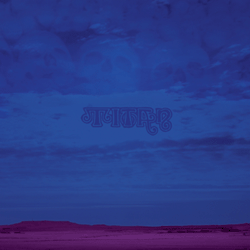
Titan—A Raining Sun of Light and Love For You and You and You (TeePee)
Titan play progressive rock stripped of all niceties and prissiness. While bands like Spock’s Beard and The Flower Kings have done their bit to keep the genre alive, their mega-polished albums and tidy chops obscure the fact that progressive rock was once underground music made on a shoestring by starving, spotty-faced lads. Where’s the scuzz? Where’s the musty cottage intrigue? Where's that creaky, overdriven sound that John Anthony got for Genesis and Van der Graaf Generator during their peak years? Titan have hitched themselves to that spirit and are plowing a wide, fetid swath across the prog landscape with it. The album opens with a short acoustic passage and a verse of warbling vocals before accelerating full-throttle into the song proper (titled "Annals of the Former World"), sounding like Black Sabbath jamming on the heaviest parts of “The Knife” or “The Musical Box.” Charge! The pace picks up and the sound's not a million miles away from the swirling, sustained freakouts that Comets On Fire reveled in on Blue Cathedral. The approach isn't overly mathy, but the band does execute some tricky runs and changeups. The second track recalls ELP at their nastiest (I'm thinking Trilogy-nasty, not Love Beach-nasty) along with the gnarly approach of Tony Williams Lifetime. The digipak sticker also references Mahavishnu, which I didn't hear initially, but it's present on this track for sure. Guitarist Josh Anzano excels with his noisemaking, but really the whole band is almost constantly going for it. They can play, no question. Dan Bates' bass tone alone is a frightening thing, and when combined with Kris D'Agostino's haunted, overdriven organ and Dave Liebowitz's drums, the chaos is beautiful to witness. There's no letup until the second track's spacey, ominous denouement. Track three begins with feedback and what sounds like throat-singing or didgeridoo before rocking out on a Hawkwind kind of feel under a blanket of phase shift. A quick gear change into a frantic 3/4 bulldoze and we're in danger of being ground up beneath the treads. Thankfully that lets up and we can remember how to breathe during the ensuing synth interlude and the segue into the final track, an insistent Can groove against a pulsing synth drone. Titan are a refreshingly rowdy take on '70s prog and its various offshoots—space rock, Kraut rock, and so on. You could probably throw in the entire Vertigo Records catalogue while you're at it. Like Zombi and Guapo, their enthusiasm for the more obscure tangents of the genre, coupled with pure instrumental bluster, has produced an album that pays homage to the past yet sounds cutting edge in this self-conscious and hidebound world.
Subscribe to:
Posts (Atom)